Friday, 14 October 2011

Leaving Poland

We've had a really enjoyable, albeit brief, trip to Poland.  There's plenty more to see and do but we're about to head west again, partly because life in a motorhome is getting more tricky as campsites close up for the winter, and partly because we have a parcel to collect from Lübeck post office (we hope).

After our last blog we visited the Slowinski National Park in the north of Poland, on the Baltic coast. Here we spent a lovely day walking through the forest, spotting a red squirrel with the biggest bushy tail we've ever seen, climbing the sand dunes (which apparently move so rapidly that they are “regarded as a curiosity of nature on a European scale” according to our guide book) and strolling along the beach looking for amber.


We continued our way east along the Baltic coast to Gdansk, then cut back inland to Malbork and Torun.  We had a couple of nights in the little town of Znin, then to our current location in Poznan.  The weather has got colder and wetter but we've had enough sunny intervals to get out and about, in fact most of the rain has conveniently fallen during the nights.

Gdansk is spectacular.  Richard has wanted to visit it since he read a couple of Günter Grass novels in the 1980s.  One of the novels described how the old town centre was devastated close to the end of the war, but how the proud townsfolk were determined to rebuild it just as it was (at least those who were able to stay – see below).  They've done a great job of it.

Town Hall, before and after restoration

The old centre is lined with brightly coloured and ornately decorated old houses, but they have also restored (maybe not as thoroughly) the outlying streets so they also have the tall terraces and varied gables of the old city.  It's an atmospheric maze of streets. The limitations of the restoration can be seen here and there; the old carved grave slabs on the floor of the cathedral are almost all cracked and pitted, one house has replaced the pieces they could find of an elaborately carved doorway and it makes a sorry jigsaw.


But the thing they've really been unable to restore is the society.  Grass described a thoroughly mixed and largely harmonious Polish / German city with a lively community.  In modern central Gdansk there's hardly a shop that's selling anything for anyone but the tourists, all the grave slabs in the cathedral bear German names but the only German spoken is by visitors.


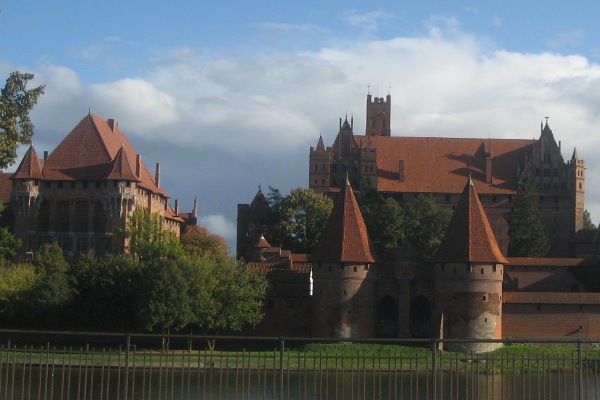
Malbork used to be Marienburg, the massive brick fortress HQ of the Teutonic Knights who originally established Prussia.  It was a very important national symbol to Prussia and to newly unified Germany which lovingly restored and embellished it during the 1880s and 1890s. Unfortunately all that restoration work went to waste, as those later German nationalists led by Mr A Hitler also loved it and refused to give it up without a fight. The new Polish owners had to start all over again.  It is a spectacular monument to the power, wealth and piety of that strange band of warrior monks who spread the Good News through the Baltic at the point of a sword.


Torun was unusual amongst the places we visited, as the Red Army seems to have been able to stroll in while no-one was looking and it didn't suffer much damage.  It's a compact mediaeval town with a lot of interesting old buildings. It is also home to a large university population and has a 'young' and educated feel about it. The people we spoke to there in shops and restaurants spoke excellent English and were happy to chat to us and tell us local stories.

Torun.  The Teutonic Knights' outside toilet (seriously!)
 
Since Lübeck it's been Brick Gothic all the way.  Baltic Poland and Germany are built on alluvium, the biggest pieces of rock are glacial boulders rarely bigger than a washing machine.  It's many hundreds of miles to the nearest decent building stone, so their mediaeval houses, cathedrals and fortresses were all built of brick.  It takes some getting used to – at first glance many venerable Gothic buildings looked to us like a Victorian railway station. The lack of building stone had another strange effect – in Malbork some of the 14th century tracery and figures were made from 'artificial stone', something we associate more with the wares of 21st century garden centres.

Poznan Tourist Information gives you a free city guide which starts “While Poznan is not the first city on the travellers itinerary...”.  Cheer up guys!  It's fine!  Nothing to be ashamed of!  The old town is centred on Stary Rynek, the old market square.  This area was also badly damaged in 1945 and rebuilt as a lovely cobbled square surrounded by colourful houses and arcades, decorated with wall paintings and sgrafitto. 


At the centre there's a spectacular renaissance town hall with a clock tower that puts on a little show at noon; a bugler plays and two mechanical goats butt heads 12 times. Stella particularly liked this.


North of the centre there's an area that was redeveloped in the late nineteenth and early twentieth centuries as a showpiece of modern Prussian style (yes, them again).  It might not be what the Poznan people would have chosen but they've inherited some spectacularly bonkers neo-Gothic buildings as well as a bit of neoclassical and art nouveau which we think they're now quite fond of.

Poland has had a truly horrible history that you wouldn't wish on anyone.  Everywhere we visited up until Znin had been part of Prussia up until 1945, captured by the Red Army, the population expelled and the land handed over to Poland.  I've been very aware that all those elegant Victorian apartment blocks were once occupied by Germans who in 1946 suddenly found themselves in displaced persons' camps (if they were lucky) with no prospect of going home.  They probably didn't find they got much sympathy at the time, because of what their countrymen had been up to for the previous few years.  Poland was carrying out it's first post-war census, and finding that one in three of its people had disappeared. We haven't been to the south of Poland and therefore haven't come close to its most popular tourist destination - Auschwitz. We don't really want to.

Since Poland joined the EU we've heard so many more Polish voices in Britain and seen so many more Polish products in the shops.  It's been great to be able to observe the Poles in their natural habitat!  The flatness of this country has grown a bit wearing, but it's a great place for people with dodgy knees.  It has fantastic old cities (even if some of them were built in 1953), fabulous forests and wildlife, really interesting and delicious food, and remarkably low prices. 

We're going to leave wanting more.  Krakow seems to be one of the main places to see, but we never got that far south. Wrocklau is a hidden gem, so we're told. We were very tempted to make a dash from Gdansk to the border with Belarus to visit the Bialowieza National Park, but decided it needed more time and more planning to make the best of it.

Even the climate, for our visit, has been no worse than Britain.  We have seen the odd snippet of information that reminds us that we can't afford to hang around too long (e.g. the old wooden bridge over the Wisla at Torun kept being damaged by floating ice).  The sky over Torun was still crowded with geese streaming south.


Pretty soon we're going to have to follow them.

Thursday, 6 October 2011

First Impressions of Poland

Our first impressions of Denmark turned out to be wide of the mark, and our first impressions of Poland are even less likely to be accurate as the place is so big, but we'll have a go.  This is all based on a day in Szczecin and a drive from there back to the coast near Koszalin...

  • There's lots of space in this corner of Poland.  We've driven for miles through fields and forests with no sign of habitation.
  • The standard of driving is right down there with the Calabrians.  They're not quite as bad as the Italians in town, but their faith in God and the protecting spirit of Pope John Paul II gives them the confidence to pull off some breathtaking overtakes on the long single carriageway country roads.  (In 2009 they had 12 road deaths per 100,000 of population, compared to 3.8 for the UK).
  • People are very Catholic.  We saw people in Szczecin praying in front of a statue of Pope John Paul II in the middle of a busy park.  In front of the statue there was a mound of fresh flowers and lit candles.


  • It's startlingly cheap, especially when you've recently arrived from Denmark.  We had a very substantial meal in Szczecin in a small bar which cost us a total of about £5.60.  Diesel is just over £1 a litre, a loaf of good bread costs 60p.  With local products looking so cheap, imported goods must seem terribly expensive, I can't work out how there can be so many Audis about.
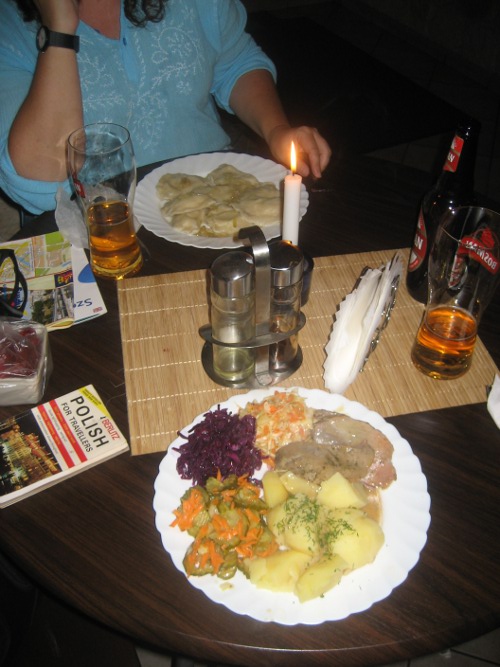
  • The food is really good.  Back during the cold war we used to joke about pork and cabbage.  Maybe it's improved but I can report that the pork is delicious and tender and the finely shredded cabbage is crunchy, sweet and herby.  Also, the pierogi is just as delicious as Italian ravioli. The street market in Szczcin is heaped with raspberries, plums and apples that are local and properly ripe, better quality than you would find in Cardiff market.


  • It's a struggle for them to get their infrastructure up to the standard in the 'old' EU.  The contrast with the former East Germany is revealing.  East Germany had a big infusion of funds from the former West Germany to help it.  From what we saw every building has been at least rendered and painted, every strategic road has been widened and resurfaced and the place looks very much like the former West.  In Poland they're having to work their way through their 'to-do' list with their own resources (plus European Regional Development Funds).  Lots of old Victorian buildings in Szczecin are dropping their façades into the street, the secondary roads are potholed and the reinforcing rods are bursting out of the bus shelter walls, although improvement work is under way everywhere we look.

  • Szczecin was obviously badly damaged in the war and was repaired rather cheaply. The 'New Old Town' (as the locals apparently call it) is a jumble of surviving historical buildings and cheap prefab apartment blocks. It's not so much a beautiful town as a town with some beautiful things in it.


  • When a Pole admits to speaking 'a little English' you can assume they speak it pretty well perfectly.  They must be setting a very high standard, maybe comparing themselves to Joseph Conrad.  This is fortunate for us, as Polish is a total mystery to us.
  • The average haircut for a young Polish man is a little too short, giving them an unnecessarily intimidating air until you get used to it.
  • Men driving trucks wear blue hillbilly dungarees, men working on the roads wear the same but orange.
  • The profit to be made from picking a basket of mushrooms in the forest, then selling it from the hard shoulder, is enough to entice hundreds of elderly Poles out into the countryside at this time of year. There are also quite a few young women standing by the roadsides, but they don't appear to have mushrooms to sell.

The weather is still lovely, warm and sunny here despite a little rain overnight. We've read that usually at this time of year it is less than 10 degrees Celsius during the day so we know we're very fortunate to have chosen this year to visit. Let's hope our luck holds as we continue our journey to the Slowinski National Park and Gdansk.

Monday, 3 October 2011

Two Poms in Pomerania.

Well this is another 'catch up' blog as we've been without internet access for a while, but busy doing things nonetheless.

We had a couple of lovely days in Copenhagen. The weather was just starting to change to warm and sunny, and we found a great spot to park, by the coast and close to an S-tog (district railway) station so we could travel to and from the city on the train.

We visited most of the major sights but probably our favourite place was Cristiania – the old 'hippy' community. It was celebrating 40 years of existence when we visited, which meant that it was a lot busier, with more events than usual. We stopped to watch a visiting Italian brass band playing in the street, and after them a group of drummers and dancers – with some pale Danes struggling to be African in feathered costumes.


Next we called into the 'Grey Hall', a magnificent mid 19th century military riding hall with a spectacular wooden roof. A lecture and debate was under way, plus a bar selling vegan food and drinks, an exhibition of architectural drawings, paintings of Christiania-ites and giant jellyfish hanging from the ceiling. As the debate ended, a violin / clarinet duo started up playing gentle slow paced tunes, a grey haired hippy couple danced to it, and we shared a beer and enjoyed it.

The 'town centre' of the place is like some kind of permanent festival site, there are lots of colourful murals and graffiti, improvised businesses with hand made signs and big signs saying 'No hard drugs, no violence, no weapons, no bulletproof clothes, enjoy Christiania'.

Further out, on the narrow 17th century battlements that extend between the old moats, we found a lovely, quiet, informal place to live. There's lots of space and trees and idyllic spots overlooking the moat, and we particularly liked the funny floating art work.


Houses ranged from smart wood clad chalets with gated gardens, to converted eighteenth century military buildings, to patched up old road menders' cabins. It's nice to walk around an area that is completely car free, though there were plenty of cyclists, many riding the Christiania-built bikes with carriers at the front for holding shopping, children, dogs and friends.


After Copenhagen we decided we needed to be away from the cities for a while and so we spent the last few days in Denmark exploring the coastline and the chalky cliffs of Stevns Klint and Møns Klint. We stayed two nights at the lovely little fishing village of Rødvig, where we enjoyed the mini heatwave sweeping across Europe, walked along the cliff top, ate apple cake and watched the birds flying south. 


This is why we wanted a van with back doors.


On the island of Møn we braved the steps down to the beach (nearly 500 steps) so that we could look up at the gorgeous, glittering cliffs and walk along the beach looking for fossils. Stella didn't enjoy the steps back up, but the mouse, tiny toads, variety of small birds and a sighting of a black adder helped make the climb more bearable.


On 29th September we caught the ferry to Puttgarten in Germany, and started to make our way east along the Baltic coast. We've visited a series of the old Hanseatic trading ports, places that used their mediaeval wealth to build soaring spectacular cathedrals and imposing merchants' mansions, all in brick. We have read the term 'brick gothic' many times in tourist guides over the last few days.


Lübeck town hall

Today (3rd October) we crossed from German Pomerania into Polish Pomerania, swapped one stretch of reedy coast where we can barely understand anything for another stretch of reedy coast where we can understand nothing! We've settled this evening in a smart campsite on the outskirts of Szczecin, getting our bearings, getting some Zloty and planning to visit the city tomorrow. Fortunately the campsite owner speaks excellent English.

Saturday, 24 September 2011

Land of Castles

West Jutland is apparently colloquial Danish shorthand for 'in the middle of no-where', so that may be why we had an initial impression of an underpopulated land with little history. We've seen a lot of Denmark since our last blog, and considerably updated our first impressions.

From Skagen our route took us down the eastern side of Jutland, then across the Little Belt straights to the island of Fyn, then across the Great Belt to Sjælland.  We're now in the north of Sjælland in the seaside town of Gillelege.  The countryside we've been passing through is scattered with beautiful half timbered houses, many with thatched roofs, as picturesque as anything from any tin of west-country clotted cream fudge.  Plenty of history here.


We even visited an open air museum in Arhus - 'Den Gamle By' – which is a collection of old houses from around Denmark. The oldest are from around 1550 and the most recent additions are shops recreating life in the 1970s (as if that's history!!) There are a varirty of buildings including some which have staff in period costume performing household tasks and a bakery where you can buy the goods (modern prices apply unfortunately).


Another thing their history has given them is an embarrassment of castles, so many we've had to be rather picky about which ones we visit.  The ones we've seen haven't been the massive stone Norman fortresses we're familiar with from Wales, but much later and more comfortable buildings.  Many of them look so decorative and airy that it's hard to see them as having a defensive purpose, but as you approach you find them enclosed by elaborate earth embankments, moats, drawbridges and gun emplacements.  The castle itself may be tougher than it looks, but the main defence is in the earthworks, where every star shaped battlement is covered by the guns of its neighbour and the  attacking enemy can fire as many cannonballs as they like into the earth embankments and they're never going to crack – this is military engineering for the age of gunpowder rather than the crossbow.


Egeskov castle is not a huge place compared to Caernarfon or Blenheim Palace, it's more a fortified manor house than a castle, but it's the centre of a large and thriving estate.  The last few generations of the family have opened it up to the public so that income from visitors can supplement the profits from the surrounding agricultural land.


We hesitated about the entrance fee, but found it to be superb value with something for everyone.  Before visiting the castle we thought we'd peek into the barns where there were exhibitions of old cars, bikes and rescue vehicles.  We found ourselves spending the whole morning wandering fascinated past a vast collection of immaculate vehicles (yes, even Stella and she's a girl!), many dating back to before the first world war.  They have everything from a Wallace and Grommit style grey Austin A40 van to a Danish airforce Starfighter.


The current owner, Count Michael, seems to be a bit of a character, and is enjoying his inheritance.  A keen diver, he's thoroughly explored the moat and brought up all sorts of debris.  In the banqueting hall is a tailor made suit of armour, fulfilment of a childhood dream, based on armour made for the man who originally built the castle.  The banqueting room displayed several pairs of duelling pistols, from as late at the mid nineteenth century.  Michael thought that as he was Count of Egeskov he should have a pair, but this being the 21st century he had to settle for a pair of paintball guns – displayed in a case with the words of the duelling ritual typed out and hand corrected.

Freidericia is clearly a military town (parts of it reminded us of Berwick Upon Tweed, with smart but plain neo-classical buildings keeping their heads down behind dominating ramparts).  In case you forget its military history, the pedestrian crossings display a red soldier standing to attention and a green soldier marching. 


The ramparts are now a pleasant green space for the townsfolk with swings in the trees. They don't seem to have been very effective as defences as the 17th century Swedes got in, followed two hundred years later by the Prussians.

All that remains of the outer wall of Nyborg's royal castle is two towers and the intervening stretch of battlement, with a grand hall built up against the wall.  Beyond this are more 17th century earthwork battlements which in turn overlook a wide moat.  Now its military purpose has passed, the moat is a lovely lake crowded with ducks and swans, and overlooked by some very desirable houses.

Then there's Frederiksborg, where spectacular grounds lead you down to a spectacular baroque palace.  The baroque formal garden was built by Frederick IV, it's very elaborate with Italianate fountains and statues, and neat hedges which spell out Frederick's monogram.  The castle itself is one of those that looks too decorative and frothy to be a fortress, but it stands in a moat so wide it is more like a lake.


Fredensborg Castle is a grand neoclassical palace approached by a long wide carriage way.  We just peeked through the gate (we were castled up to the eyes by this point).

Kronborg Castle in Helsingør (Shakespere's Elsinore) is one of the 'must see sights' in Denmark according to our guidebook, and we were pleased to spend the night in a parking spot at the marina with a view of the castle through our back windows.


It was built to control shipping between the North Sea and the Baltic.  Denmark made a lot of money over four hundred years by imposing tolls.  The castle is a sixteenth century fantasy of spires and decoration, but in Shakespere's time it was famous for its strength as well as its luxury.  You approach it through line after line of defences, overlooked at every moment by the Danish Department of Palaces' beautifully restored guns.


And for each of the castles we've visited we've ignored two or three other tourist signs saying “'Slot' this way”.  There are plenty more to see.

It's not been all castles, we've seen some other interesting sights, notably the Frigate Jylland (a nineteenth century warship, the largest surviving wooden ship), the Roskilde Viking ships and the Jelling runestones.


We've found that being without Scooby has led to us spending more time on sightseeing and less time walking on beaches. It's costing us a fortune and we're constantly looking enviously at dog owners. It has also led to us wanting to spend time at attractions with furry mammals to look at; oddly these seem to be aquariums. In Silkeborg we visited the freshwater aquarium and as well as a wide variety of fish, repiles, amphibians and water fowl we cooed over goats, beavers, raccoons, mink, coypu, raccoon dogs (which we'd never heard of) and best of all, a pair of gorgeous otters who put on a great show for us.


We're currently parked up near Gilleleje, on the northern edge of Sjælland, planning to head south to Copenhagen tomorrow.

Sunday, 11 September 2011

The Land Of Light

The local tourist authority takes every opportunity to refer to this region as the Land of Light in whatever language they're using, so we may just as well just go along with it.

We continued up the coast to Løkken, a shuttered holiday town with a fabulous long beach of squeaky fine sand, backed by towering sand dunes.  Near the town the beach was pretty busy, with a truck removing beach huts to winter storage, lots of walkers, cyclists, people daringly driving a red Fiat on the wet sand and a couple of people on trailbikes.

A group of young Germans were standing around a seal pup which was on the beach just above the surf. It looked very healthy and didn't seem at all worried by the attention, and when we walked back later it had disappeared so we guess it was just having a rest.


Just north of the town, the beach is littered with the remains of a huge second world war concrete fortress. Some are still high up in the dunes, peeking out of the sand, others have been undermined by the sea and slipped down as a massive concrete monolith, lying at crazy angles in the sand.  Some are obvious gun emplacements, others' functions are less clear.  Concrete steps and passages lead in all directions, often blocked by drifts of sand, some ending in a 'Clanger' style porthole on the blockhouse roof.

On the blockhouses we found the first substantial collection of Danish graffiti, some very odd; someone had written words like 'Gillette', 'Volvo', 'Clearasil' and 'Commodore 64' neatly on the blockhouse walls, each with an arrow pointing upwards.  Even more unusual, the whole of 'Shall I compare thee to a summers day' was written out on the wall of a narrow concrete passageway.


None of the photos we took of this complex could capture the scale of it.  It needs a satellite view to see its full extent.

Next stop was Hirtshalls, approaching the northern tip of Jutland.  Danish camp sites have been excellent but we've been paying a lot for facilities we don't really need.  We found a website  that reassured us that overnight parking (as distinct from camping) was allowed in Denmark.  If you stop for one night in a motorhome and all your activities are inside it (you don't hang out washing, put chairs out, wind out your awning etc.) it's considered to be parking rather than camping.  A similar distinction exists in Spain.  The website recommended  Hirtshalls' beachfront carpark as a place to spend the night, and it was indeed a lovely, quiet place to stay.

Hirtshalls is a modern working fishing port, very different from Løkken, with its quay crowded with sturdy looking fishing boats.  Consequently it's a little livelier out of season, although the streets were pretty quiet during the evening as the rain rattled in from the North Sea.  Our local pub, the Skipperkroen, was advertising live music from Jesper Hostrup so we went in to sample Friday night in Hirtshalls. 


The massive laughing barman in his Paris Hilton T-shirt was the first Dane we've met without even a smattering of English.   A small crowd of weather-beaten people stood at the bar; almost everyone drinking bottles of Tuborg and smoking as if they were burning cables.  It was quite like a pub from the past. Everyone had a jolly evening but we have no photos, for obvious reasons - we got stared at quite a bit as it was.

The band started just after ten; two bearded blokes with guitars and Stetsons.  What we can remember of the set list; 'The Joker', 'Irish Rover', 'I'll Be Your Baby Tonight', 'Help Me Make It Through the Night', 'Folsom City Blues', 'Fal-de-Ree / I Love to go a Wandering' (special request from a burly trawlerwoman just before we left) and a couple of songs in Danish.  Perhaps they sang 'Rawhide' and 'Stand by Your Man' after we left.

The following day (Saturday 10th) we popped into the North Sea Museum, which the guidebook told us had a good aquarium.  It turned out to be spectacular, with massive tanks containing species  illustrating a representative selection of North Sea habitats.


There was lots of good information (in Danish, German and English) on marine life and fishing, videos and interactive exhibits and some real treats including three huge sunfish, a taste of fried and marinated Greater Weever Fish, a chance to watch Harbour Seals and Grey Seals being hand fed astonishing quantities of herring and a rare opportunity to stroke the felt wings of a friendly ray.


We could have spent hours watching the shoals of mackerel and bonito circling the big pelagic tank, seahorses dancing, crabs wrestling, but we tore ourselves away and continued north to Skagen. There we spent the night tucked up in another 'wild camping' spot - a carpark almost in the shadow of the windmill in the grounds of Skagen's By & Egns museum. Skagen is clearly a very popular seaside resort in the summer and boasts some lovely seafood restaurants in the harbour area. We ate at one of them and Richard tried what seems to be Jutland's speciality dish; 'Stjerneskud' translated into 'Shooting Star' on menus.  It consisted of a piece of fried breaded plaice, a piece of steamed plaice, a piece of toast topped with sweet mayonnaise, prawns, asparagus, some salad and a little fish roe. Very good.

This morning we visited the so-called Buried Church – Tilsandede Kirke – which was rather disappointing; not as 'sand engulfed' as the guide book suggested, then had a lovely walk through the sand dunes and back to the van along the long, sandy beach. After that we drove to Grenen (the Branch) which is the sandy, shifting headland marking the northernmost tip of Denmark. Here we walked out to the furthest point to see the waves from the Skagerrak and the Kattegat clashing together as the North Sea and the straits of Denmark meet. Along the way we came across another baby seal having a rest and being photographed from every angle by tourists.

Having reached the tip of Denmark it's south from now on, with a bit of east and west thrown in for good measure. Our current location is a peaceful farm site about 10 km inland from Frederikshavn, where we're making the most of today's hot and sunny weather by doing some washing.

Our very expensive Danish mobile internet access runs out this evening, so we might go quiet for a while.

Friday, 9 September 2011

First Impressions of Denmark

Based on a couple of days in West Jutland, in no particular order....

  • Clean, well ordered.  The campsite toilets are like hotel toilets (and by that we mean the Hilton, not the Walsall Travelodge).  There's no litter, no graffiti, nothing ever seems to be broken.
  • Everyone's been polite and friendly, speaking excellent English (as well as German usually).
  • Flat flat flat.  Not completely, but a hill is a bit of a high point
  • Strangely free of tradition.  People have been living here for millennia, but almost everything seems new.  The supermarkets are full of Mediterranean food, the farming is modern and efficient with no obvious emphasis on traditional local products.  The towns (Ribe excepted) seem to have few buildings more than a century old.
  • Maybe related to that, they seem ready to innovate.  The alternative energy park near Thy was demonstrating wind turbines and wave energy generators that are actually being built and supporting a substantial industry.  Wind turbines are plentiful across the countryside.
  • Expensive (though apparently not as bad as Sweden).
  • Not many people.  The roads are quiet (and in many areas most of the other drivers have  been German holidaymakers), the towns are small and well spread out.  Feels a bit like New Zealand sometimes.

West Jutland

Our first stop in Denmark was Ribe; Denmark's oldest city.  We camped in an amazingly plush campsite on the outskirts, but it was an easy walk into town. 

We might not have heard of Ribe if Simonl Calder of the Independent hadn't failed to hire an Avis car in northern Denmark, and consequently failed to get to visit.  His article complained about Avis's customer service, and that he couldn't get to the town without a car.  In fact we found it has a rather grand railway station, but he wasn't to know that.

The historical centre is a network of pretty cobbled streets lined with old houses.  Many are built from a timber framework with brickwork infill, dating back to the sixteenth century when much of Ribe was rebuilt after a fire. Others are cheaply built terraces of single storey houses from the seventeenth century, with a scattering of more elegant neoclassical houses from the eighteenth and nineteenth centuries.  On the outskirts there's a grassy rectangle surrounded by a moat, which was once Ribe's royal castle.  Little remains now.

Ribe was Denmark's first substantial town, and for years its biggest port.  It fell on hard times, so couldn't afford to rebuild, so the town centre is well preserved.  Walking round, and knowing this story, it's clear that Denmark has never been richer than it is now.  There are some nice old buildings in Ribe but they're not grand – the old half timbered places reminded us of Knighton or Ludlow, it certainly wasn't competing with Bremen or Venice.  Many look like tarted up slums.  It looks like a town built by people who were earning a pretty tough living.  In contrast, today, everything is immaculate.  You can't help peering in through the windows of a seventeenth century hovel, ceilings too low to stand up properly, and seeing chic designer lamps, original sculptures and classically smart 1960s Scandinavian birch ply furniture.


Ribe is working hard to recapture some of its old prominence.  Every evening in the summer you can join the town's night watchman as he patrols the streets and tells you about the history of the town.  We were lucky to catch one of the last tours.  It was impressively atmospheric, trudging the quiet cobbled streets behind the watchman as he sang the traditional songs, pointed out interesting buildings and told tales of Ribe's history of ships, pirates, witches and floods (fortunately for us, in very good English as well as Danish).


We were doubly lucky to catch that tour, because the following day brought wind and torrential rain, and we spent a day huddled in our cosy van while the wild weather raged outside. As it started to abate we continued north up the west coast of Jutland, through flat sandy country along straight roads lined with maize fields, cereal stubble and potatoes.

The coastal road runs along a line of dunes between the wild north sea and a series of freshwater lagoons (Fjords in Danish, very different to those in Norway).  The beaches here are clearly very busy in Summer, but during our visit they've been populated only by a few brave souls and their dogs, getting sandblasted as they walk. We planned to spend Stella's birthday walking along the beach but the wind was so strong that day that we could barely stand up.


So we huddled in the dunes and watched the waves crashing and foam dancing around for a while and then retreated inland to shelter in the woods for the night. In places the dunes are vast, scattered with holiday villages but also nature reserves.  We know enough to know we're seeing glimpses of the great autumn migrations but not enough to know exactly what is flying past us.

Wildest wildlife spot so far was a tiny adder sunning itself on the side of the path in the dunes.  We didn't put a hand in the photo for scale, as although it was tiny it was armed, but it was about the diameter of a pencil.


This morning we're enjoying the calm and the sunshine just outside Thy National Park.

Monday, 5 September 2011

Travels in cheese country


To a degree it's like home, a wet green landscape ideal for growing grass and turning it into milk, but here it's flat, flat to the horizon of trees five miles away.  The straight roads follow straight drainage canals for mile after mile.

We spent the last night of August in the carpark of a cheese and clog factory on the outskirts of Edam.  That might not seem like a natural combination, but if you have a carpark big enough to host motorhomes and tourist coaches it makes perfect sense.


A very helpful woman showed us around their vast shop and talked us through the cheese making process.  It seemed very similar to the cheese making process in other places; it's amazing how one can turn out creamy and crumbly and another one smooth, elastic and spicy.  Subtle differences of timing, temperature and inoculant obviously make a huge difference.

We went away with a small Gouda cheese, which was remarkable for two reasons;
  • It was made in Edam.  Apparently as long as you follow the recipe you are free to make Gouda in Edam or Edam in Gouda.  You can't imagine the French standing for that.
  • It's a delicious 'Belegte' mature cheese, smooth and dense but as piquant as a mature cheddar.  The Dutch cheeses you get in Britain always seem to be mild, bland and rubbery, but here they sell ones that have been matured for months or years.  They even had goat's milk cheese and crumbly cheese which was harder and more pungent than an Italian grana.  It seems they keep the most interesting stuff for themselves.

Before our night outside the cheese and clog factory we'd walked to the centre of Edam just in time to see the wooden stalls of the weekly cheese market being packed up and driven away.  After we left Edam we parked and rode into Alkmaar only to find the cheese market was finished for the year.  On our way north Richard was keen to call into Hoorn, because he knew he'd been there before and had liked it, even though he couldn't remember much of it.  In the town centre we were surprised and delighted to see a sign advertising a cheese market at half past eight – the last one of the year!

We parked the van in Hoorn Marina, walked into town and settled ourselves at a table outside a pub on the market square.  We were surrounded by magnificent buildings from the sixteenth to eighteenth centuries, leaning against one another like a crowd of drunken friends as their foundations settled in the marshy ground.

The chief cheese lady took pains to emphasise that Hoorn used to have the biggest cheese market in the region (maybe a dig at Alkmaar and Edam).  It closed in 1949 as cheese production became concentrated in larger factories.  It's a tradition they miss, so they re-enact the market twice every Thursday in the summer.

The show started (for those of us who'd arrived early) with a big yellow refrigerated wagon being towed into the square by a Jeep, and then crashing into the back of that very Jeep.  An army of volunteers started unloading hundreds of big cheeses from the wagon and stacking them around the square.

When the re-enactment began in earnest, a bell was rung signalling the beginning of the market.  Cheese experts took samples from the cheeses to assess their quality, then they were auctioned.  Cheese carriers took eight cheeses at a time on a wooden platform suspended from straps from their shoulders, carried them across the square to be weighed, then across to horse drawn wagon to be taken to the warehouses (they were actually being returned to the yellow wagon with the dented bonnet).  This was accompanied by women in traditional Dutch costume dancing in their clogs, people in mediaeval costume offering tastes of syrup waffles and selling small cheeses.


Since it was the last re-enactment of the year everyone was in high spirits.  Beemster Cheeses had sponsored the whole event and provided what must have been thousands of pounds worth of cheese for the show, much of which was being dropped or slung surreptitiously into car boots around the square.  It was a little poignant to see the square full of identical cheeses – Beemster being exactly the sort of big dairy that killed the old market and the variety that must have once existed, but it was great  fun for participants as well as spectators.


On our way from the Netherlands to Denmark we stayed in Germany for two nights – taking advantage of their free overnight parking places for motorhomes. Some of these are in lovely spots, and very generous; the first one we stayed at had free electricity. We also stopped in Bremen, wanting to have a look at it without really knowing why.

We caught the train into Bremen Hauptbahnhof, and emerged from the station to a cityscape of rather stark post war buildings – a bit like Kingsway Swansea with a bigger budget.  We were relived to find the old town square with its mediaeval cathedral, town hall and giant statue of Roland (the Christian hero from the Dark Ages who we keep running into on our travels).  There was a lot of space around these monuments.  It was pretty obvious that this was a town that had taken a pasting in the war and had to be rather selective about which buildings they tried to save.


One district, Schnoor, had survived relatively well.  The warren of mediaeval streets is now full of tourist shops and restaurants.  In its heyday it probably wasn't half so chic!  It was interesting to see the Dutch style gables on the houses, carved panels above the doors and inscriptions in language that wasn't quite Dutch and wasn't quite Deutsch.  When these homes were built, Bremen was an independent city state.  The Netherlands was a patchwork of provinces, nominally ruled by distant emperors but in practice independent.  The cultures were aligned quite differently to today. Friesland meant something long before Netherland or Deutschland had been invented.

After that we pushed east and north, past Hamburg and heading for Denmark.  We noticed Germany is scattered with these road signs, anyone know what they mean?


This blog update is posted from Ribe, the oldest city in Denmark, celebrating the fact that we've managed to find a mobile phone shop and buy a Danish SIM card which gives us a week's access to the internet.