Saturday, 5 November 2011

Fal-de-ree, Fal-de-rah...!


A friend has said that our previous blog entry gave the impression that we may be getting a little jaded, or perhaps are not that keen on Germany. That's far from the case! However, as we're now travelling without a dog, we're spending more time in cities and towns instead of interspersing all our city visits with beaches and forests; this can sometimes result in seeing too much, too quickly and leaves us a bit breathless. Since writing the last blog we've slowed down a bit and taken the time to do some walking in the mountains and see some of the beautiful countryside in this part of the world. We are refreshed and enjoying it very much.

Before reaching the mountains however, we had one more big city to visit – Dresden. If we were starting to think that one big city was much like another, Dresden soon changed that.

The name Dresden has some grim associations.  One of Germany's most beautiful cities, a centre of music, art and literature, it survived undamaged until almost the end of the war.  In February 1945 British and American bombers carried out a series of raids specifically designed to set the city ablaze.  It worked a treat.  The result was massive loss of life and destruction of the beautiful old city.  After the war, parts of it were rebuilt, but we wondered how much we'd really find left to visit.

Still a centre of musical culture (thought the Aussies would like this as much as the Ossies)

We entered the old town via the old market place, a rather bleak square overlooked by a few old buildings and the communist era 'Palace of Culture' (a concrete and glass rectangle with a heroic mural on the side).


From there, the architectural thrills came thick and fast.  Every corner we turned revealed a spectacular new scene, one flamboyant building after another. Someone once referred to Dresden as 'Florence on the Elbe', but we thought that was somewhat wide of the mark.  Dresden's fine buildings were erected by Saxon royalty in a baroque style, much more frothy than Florence, but 'Catania by the Elbe' maybe doesn't have the same ring.  Just as the buildings started to remind us of the baroque towns of Sicily however, we'd notice the ornate façades soaring up to a very German looking stepped gable or an onion dome – Dresden is very much its own place. The main thing that it has in common with Florence is the overwhelming number of gorgeous buildings in the centre – sometimes we didn't know which direction to photograph first.


The Frauenkirch is an extraordinary building with an extraordinary story.  Which of these buildings is the oldest and which is the newest?


The spectacular seventeenth century church in the centre, that looks like it has been freshly cleaned, has in fact been freshly built.  From 1945 until the 1990s it was a heap of rubble, kept as a war memorial by the DDR.  From 1995 they started rebuilding it just as it was, much to the delight of Dresdeners. Now the Frauenkirch soars over the town, which has finally regained it's pre-war skyline.  The Dresdeners love it – the distinctive silhouette appears everywhere from sweet boxes to beer labels to Christmas decorations.

From the north bank of the river we watched the paddle steamers docking and the sun setting behind the old city.  From there we could see the results of the wartime damage more clearly.  Directly opposite us, and for ten degrees right and left, we could see a beautiful, intact baroque skyline. Outside this arc it's concrete rectangles to the horizon.


After our tour of Dresden's old town we headed off to the mountainous country on the Czech border, the mediaeval towns along the Elbe and the 'Saxon Switzerland National Park'.  We've been back on the track of the German Romantic landscape painters, we've clambered over castles and looked out over cliffs so high it felt like an aerial view. Just the sort of thing we like.

Our first stop was Bautzen - a town so perfect for photos that it must be a delight for postcard makers. 


We wandered around enjoying the scenery and lack of crowds. We even managed to catch the town market and bought 4 enormous bilberry filled steamed dumplings which we've been eating ever since.  This part of Germany sits on the ancient frontier between the Germanic lands and the Slavs.  In Bautzen the streets are named in both German and Sorbian – the language of the local Slav minority.


Another pretty town that we had a stroll around was Hohnstein, (though actually it was more of a 'clamber over' as the town is very steep). We climbed through a series of mediaeval gateways and passages into the castle (now a spectacular youth hostel) and it was strange to emerge at the top into the open – no battlements.  When you look over the edge however you can see why – sheer or overhanging cliffs plunging about 40 metres into the forest.


 The next stop was Bastei, which is the most visited place in the National Park for good reason. It's a spectacular site. Autumn may be the perfect time to visit as the trees are glorious at the moment (though it must be fabulous at any time of year).   It has viewpoints looking over a side valley of the Elbe that is full of spectacular sandstone pinnacles. 


At some stage there was a castle in these pinnacles; there's a fenced off area which has a reconstruction of part of it. Now it's part nature reserve, part climbing centre, with a hotel and several cafés.  We loved it, though it was pretty chilly being so high up.


After Bastei we spent the night in Stolpen and had a wander around town next day.  It's famous for its sandstone and basalt rock.  At the base of the castle we could see hexagonal columns of basalt lined up like organ pipes.


We're currently settled in a comfortable campsite in the forest near Bad Schandau, surrounded by bulbous sandstone crags and dense forest incandescent with autumn colour. 


We spent today walking in the forest – catching a hundred and thirteen year old tram up to a famous waterfall, then taking a roundabout route back to the camp site.


Someone's also been missing the wine talk.  I'm sure we'll get back to it as we head south, but for the moment we're not in wine country.  Every town has its local special hooch, but around here it's all herb schnapps with pictures of goblins on the label.  Every town also has its own lager – it's amazing how many local breweries have survived here (and in Poland) compared to the UK.  As for the food, it's distinctive and unfamiliar but hearty, filling and delicious. We've often wanted a lunchtime snack and ended up eating so much that we're full for the rest of the day. The many different types of bratwurst are very popular indeed.

Sauerfleisch mit remoulade und bratkartoffeln in Dresden

This part of Germany is fascinating, with the influence of the Slavs to the east, its history as central European frontier territory and its more recent experience under communist dictatorship.  This area also feels in some way like the German heartland, somehow more German than Hamburg – a taste of the good old Germany of Prince Albert, JS Bach or Herman Hesse.  They love their apfel strudel, the shops are full of wooden Christmas decorations and little wooden figures, they still use elaborate Gothic script and occasionally dress up like the chap at the top of this page to go for a walk. We've also found that we've had to dredge from memory and use our limited German (accompanied by pointing and gesturing) as we've found very few shopkeepers or campsite owners who speak any English.

The language is going to get even more fun tomorrow as we're planning a short trip into the Czech Republic. We'll let you know how we get on.

Monday, 31 October 2011

A Journey to the Mysterious East

A very quick roundup of our route since the last entry: Poznan to Berlin, Potsdam, Lübeck again, Hamburg, Hannover, the Harz Mountains, Goslar, Gotha, the Thüringian Forest, Leipzig, Colditz and now Dresden.


It's interesting to look back at what impressed us and what didn't.  We're being economical on this trip so we're not much impressed by places that have fantastic theatres or deluxe restaurants.  We've seen so much over the last year that places that once might have impressed us if we'd turned up for a few days city break from work fail to move us now.  What we've enjoyed most is the places that have distinctive local character.

Germany, like Britain, has a lot of old cities that boomed during the Victorian period, resulting in wholesale redevelopment and the loss of much of the historical cityscape.  They have a term 'Gründerzeit' for the buildings that sprung up between German unification and the First World War.  The 'Gründerzeit' areas look much alike (and much like Cardiff's Pontcanna or Newport town centre).  Also like Britain (but more so), it has a lot of cities that were devastated during the war.  They've often gone to great lengths to rebuild the main buildings of the historical town centre, but you also get large areas of hurried reconstruction that look much alike (and much like Portsmouth or Swansea).

We've repeatedly crossed the old internal border between what was the Federal Republic of  Germany and what was the German Democratic Republic.  After two decades the border is blurring, and the remaining differences are often hard to spot.  Where we are now – well to the east in Saxony – you see more empty or neglected buildings than you would in the west.  In many towns there's still a sense of having been rebuilt in a hurry on the cheap, and not quite finished – old houses covered over with cement render, new flats bolted together from concrete panels, garden gates welded up from reinforcing rods.  It feels a little like the difference in atmosphere between Bristol and Swansea; you don't necessarily need a wall with guards and minefields to create divisions (although no-one swims the Severn Estuary to get to Bristol, an important difference).

Many of the large towns and cities have lovely features; usually the old town hall and an impressive church or two, but after visiting a few of them it gets hard to remember which lovely thing was in which place. Fortunately for us the sun has usually been shining wherever we'd visited, which always makes a somewhere look better. Here is a quick round up of the things we particularly enjoyed in some 'big name' places.

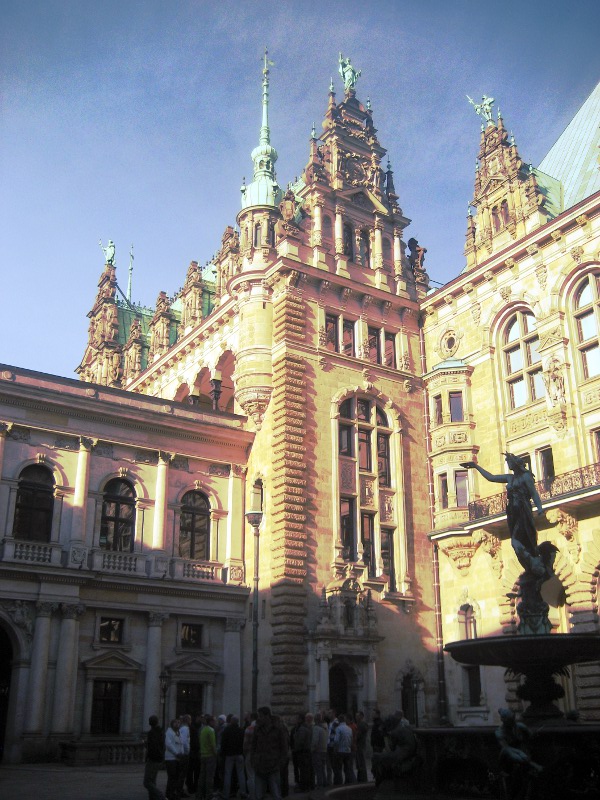
Hamburg is one of the places that suffered both from a Victorian boom and 1940s bombs.  There's nothing left of the mediaeval Hanseatic City.   It's a big city with a lot going on, a lot of characterless shopping streets but has an extremely impressive town hall, interesting docks right in the town, and a U boat.


When we researched Hannover we were warned that most of the interesting old buildings were destroyed in the war, but in fact we found it has a beautiful 'Altstat' of timber houses, a lot of nice Victorian buildings and was a nice place to wander around.  We kept stumbling across big 'lion and unicorn' coats of arms with 'Honi soit qui mal y pense' mottos that looked very familiar from home – Britain and Hannover shared their King for many years. It has a very well marked tourist route (red line on the pavement taking you around all the major sights), a huge flea market every Saturday next to the big, colourful modern sculptures called 'Nanas' and a pretty square where people sit out in deckchairs.


Leipzig has a beautiful town square and a fabulously ornate Art Nouveau café selling huge Austrian style gateaux.


Colditz castle is a very pretty building in its own right, but also has a really interesting museum about the ingenious escape attempts of the prisoners of war.


Some places deserve a bit more detail. Berlin is spectacular.  We can't believe we've never visited before.  There's little there that's pre-1870, but the centre is full of massive, imposing, impressive (and intimidating) buildings. A lot of it did feel a bit like Rome, which I'm sure was exactly what the Kaisers and the Führer intended.  But as you might expect from a major capital, it's buzzing with life, things are going on everywhere.


We blundered into the aftermath of the 'Occupy' protest infront of the Reichstag.  We walked through crowds flying kites on the runways of the old Templehof airport.  We strolled with the crowds and the street performers on Unter den Linden.  We spent hours tracing the route of the Berlin Wall and reading the free outdoor information boards. We visited 'Checkpoint Charlie'. We saw 'Trabi World' but decided not to go in. We also spent a couple of hours looking around the excellent DDR museum, trying to get a feel for what the country was like in that crazy period and what on earth Hoeneker and Co though they were doing.


After Northern Germany and Poland, it lifted our spirits to see the Harz Mountains appear over the horizon, which for weeks had been flat, flat, flat, broken only by wind turbines and water towers.  We climbed high enough to have a chilly night, followed by a long walk through beautiful autumnal beech woods and lunch on the terrace of a proper mountain restaurant with a view across a deep wooded valley to the wind blown peak of the Brocken.


While in the Harz region we also visited the gorgeous little town of Goslar. The architecture here is renovated medieval and the place is full of half timbered houses, beautiful slate roofs, intricate wooden carvings and many twisty, pointy spires. The old town hall has the most luxuriantly decorated council chamber and there is also a very elaborate mechanical clock in the town square, with all sorts of figures coming out of it (but none as funny as the Poznan goats).  We loved this place as it was so different to everywhere else that we'd been recently.


A bonus of travelling in a motorhome is that we have generally been able to avoid large commercial campsites. Instead we've relied on our German 'BordAtlas' book of 'Stellplatz' (like French 'Aires')  These are cheap, or often free, places to stay with a motorhome. They range from places that are like basic campsites to carparks to people's back gardens. Sometimes they have lots of facilities, sometimes just water, sometimes nothing. In a motorhome you often don't need anything except a quiet place to park. At the best of them we've had a free night's stay with water, waste dump and electricity. Very often we've found that they are in beautiful spots, by a river or lake, in a small town centre or here in Trebsen (southwest of Dresden), in the hotel carpark by the church. 


Today we're off to look around Dresden, then heading for the hills in the 'Saxon Switzerland' national park on the Czech border.

Friday, 14 October 2011

Leaving Poland

We've had a really enjoyable, albeit brief, trip to Poland.  There's plenty more to see and do but we're about to head west again, partly because life in a motorhome is getting more tricky as campsites close up for the winter, and partly because we have a parcel to collect from Lübeck post office (we hope).

After our last blog we visited the Slowinski National Park in the north of Poland, on the Baltic coast. Here we spent a lovely day walking through the forest, spotting a red squirrel with the biggest bushy tail we've ever seen, climbing the sand dunes (which apparently move so rapidly that they are “regarded as a curiosity of nature on a European scale” according to our guide book) and strolling along the beach looking for amber.


We continued our way east along the Baltic coast to Gdansk, then cut back inland to Malbork and Torun.  We had a couple of nights in the little town of Znin, then to our current location in Poznan.  The weather has got colder and wetter but we've had enough sunny intervals to get out and about, in fact most of the rain has conveniently fallen during the nights.

Gdansk is spectacular.  Richard has wanted to visit it since he read a couple of Günter Grass novels in the 1980s.  One of the novels described how the old town centre was devastated close to the end of the war, but how the proud townsfolk were determined to rebuild it just as it was (at least those who were able to stay – see below).  They've done a great job of it.

Town Hall, before and after restoration

The old centre is lined with brightly coloured and ornately decorated old houses, but they have also restored (maybe not as thoroughly) the outlying streets so they also have the tall terraces and varied gables of the old city.  It's an atmospheric maze of streets. The limitations of the restoration can be seen here and there; the old carved grave slabs on the floor of the cathedral are almost all cracked and pitted, one house has replaced the pieces they could find of an elaborately carved doorway and it makes a sorry jigsaw.


But the thing they've really been unable to restore is the society.  Grass described a thoroughly mixed and largely harmonious Polish / German city with a lively community.  In modern central Gdansk there's hardly a shop that's selling anything for anyone but the tourists, all the grave slabs in the cathedral bear German names but the only German spoken is by visitors.


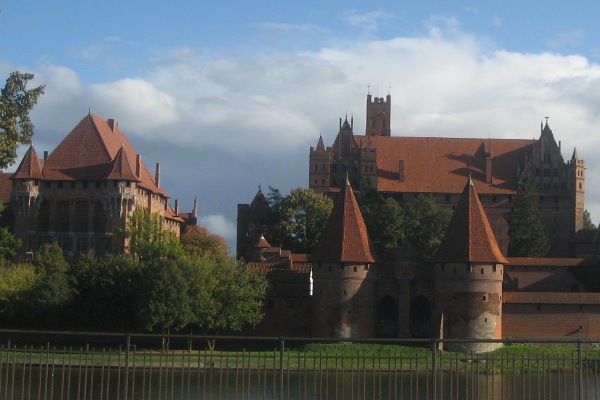
Malbork used to be Marienburg, the massive brick fortress HQ of the Teutonic Knights who originally established Prussia.  It was a very important national symbol to Prussia and to newly unified Germany which lovingly restored and embellished it during the 1880s and 1890s. Unfortunately all that restoration work went to waste, as those later German nationalists led by Mr A Hitler also loved it and refused to give it up without a fight. The new Polish owners had to start all over again.  It is a spectacular monument to the power, wealth and piety of that strange band of warrior monks who spread the Good News through the Baltic at the point of a sword.


Torun was unusual amongst the places we visited, as the Red Army seems to have been able to stroll in while no-one was looking and it didn't suffer much damage.  It's a compact mediaeval town with a lot of interesting old buildings. It is also home to a large university population and has a 'young' and educated feel about it. The people we spoke to there in shops and restaurants spoke excellent English and were happy to chat to us and tell us local stories.

Torun.  The Teutonic Knights' outside toilet (seriously!)
 
Since Lübeck it's been Brick Gothic all the way.  Baltic Poland and Germany are built on alluvium, the biggest pieces of rock are glacial boulders rarely bigger than a washing machine.  It's many hundreds of miles to the nearest decent building stone, so their mediaeval houses, cathedrals and fortresses were all built of brick.  It takes some getting used to – at first glance many venerable Gothic buildings looked to us like a Victorian railway station. The lack of building stone had another strange effect – in Malbork some of the 14th century tracery and figures were made from 'artificial stone', something we associate more with the wares of 21st century garden centres.

Poznan Tourist Information gives you a free city guide which starts “While Poznan is not the first city on the travellers itinerary...”.  Cheer up guys!  It's fine!  Nothing to be ashamed of!  The old town is centred on Stary Rynek, the old market square.  This area was also badly damaged in 1945 and rebuilt as a lovely cobbled square surrounded by colourful houses and arcades, decorated with wall paintings and sgrafitto. 


At the centre there's a spectacular renaissance town hall with a clock tower that puts on a little show at noon; a bugler plays and two mechanical goats butt heads 12 times. Stella particularly liked this.


North of the centre there's an area that was redeveloped in the late nineteenth and early twentieth centuries as a showpiece of modern Prussian style (yes, them again).  It might not be what the Poznan people would have chosen but they've inherited some spectacularly bonkers neo-Gothic buildings as well as a bit of neoclassical and art nouveau which we think they're now quite fond of.

Poland has had a truly horrible history that you wouldn't wish on anyone.  Everywhere we visited up until Znin had been part of Prussia up until 1945, captured by the Red Army, the population expelled and the land handed over to Poland.  I've been very aware that all those elegant Victorian apartment blocks were once occupied by Germans who in 1946 suddenly found themselves in displaced persons' camps (if they were lucky) with no prospect of going home.  They probably didn't find they got much sympathy at the time, because of what their countrymen had been up to for the previous few years.  Poland was carrying out it's first post-war census, and finding that one in three of its people had disappeared. We haven't been to the south of Poland and therefore haven't come close to its most popular tourist destination - Auschwitz. We don't really want to.

Since Poland joined the EU we've heard so many more Polish voices in Britain and seen so many more Polish products in the shops.  It's been great to be able to observe the Poles in their natural habitat!  The flatness of this country has grown a bit wearing, but it's a great place for people with dodgy knees.  It has fantastic old cities (even if some of them were built in 1953), fabulous forests and wildlife, really interesting and delicious food, and remarkably low prices. 

We're going to leave wanting more.  Krakow seems to be one of the main places to see, but we never got that far south. Wrocklau is a hidden gem, so we're told. We were very tempted to make a dash from Gdansk to the border with Belarus to visit the Bialowieza National Park, but decided it needed more time and more planning to make the best of it.

Even the climate, for our visit, has been no worse than Britain.  We have seen the odd snippet of information that reminds us that we can't afford to hang around too long (e.g. the old wooden bridge over the Wisla at Torun kept being damaged by floating ice).  The sky over Torun was still crowded with geese streaming south.


Pretty soon we're going to have to follow them.

Thursday, 6 October 2011

First Impressions of Poland

Our first impressions of Denmark turned out to be wide of the mark, and our first impressions of Poland are even less likely to be accurate as the place is so big, but we'll have a go.  This is all based on a day in Szczecin and a drive from there back to the coast near Koszalin...

  • There's lots of space in this corner of Poland.  We've driven for miles through fields and forests with no sign of habitation.
  • The standard of driving is right down there with the Calabrians.  They're not quite as bad as the Italians in town, but their faith in God and the protecting spirit of Pope John Paul II gives them the confidence to pull off some breathtaking overtakes on the long single carriageway country roads.  (In 2009 they had 12 road deaths per 100,000 of population, compared to 3.8 for the UK).
  • People are very Catholic.  We saw people in Szczecin praying in front of a statue of Pope John Paul II in the middle of a busy park.  In front of the statue there was a mound of fresh flowers and lit candles.


  • It's startlingly cheap, especially when you've recently arrived from Denmark.  We had a very substantial meal in Szczecin in a small bar which cost us a total of about £5.60.  Diesel is just over £1 a litre, a loaf of good bread costs 60p.  With local products looking so cheap, imported goods must seem terribly expensive, I can't work out how there can be so many Audis about.
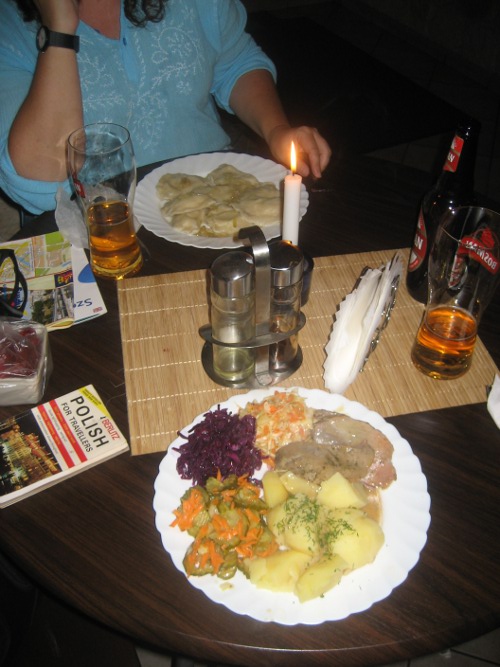
  • The food is really good.  Back during the cold war we used to joke about pork and cabbage.  Maybe it's improved but I can report that the pork is delicious and tender and the finely shredded cabbage is crunchy, sweet and herby.  Also, the pierogi is just as delicious as Italian ravioli. The street market in Szczcin is heaped with raspberries, plums and apples that are local and properly ripe, better quality than you would find in Cardiff market.


  • It's a struggle for them to get their infrastructure up to the standard in the 'old' EU.  The contrast with the former East Germany is revealing.  East Germany had a big infusion of funds from the former West Germany to help it.  From what we saw every building has been at least rendered and painted, every strategic road has been widened and resurfaced and the place looks very much like the former West.  In Poland they're having to work their way through their 'to-do' list with their own resources (plus European Regional Development Funds).  Lots of old Victorian buildings in Szczecin are dropping their façades into the street, the secondary roads are potholed and the reinforcing rods are bursting out of the bus shelter walls, although improvement work is under way everywhere we look.

  • Szczecin was obviously badly damaged in the war and was repaired rather cheaply. The 'New Old Town' (as the locals apparently call it) is a jumble of surviving historical buildings and cheap prefab apartment blocks. It's not so much a beautiful town as a town with some beautiful things in it.


  • When a Pole admits to speaking 'a little English' you can assume they speak it pretty well perfectly.  They must be setting a very high standard, maybe comparing themselves to Joseph Conrad.  This is fortunate for us, as Polish is a total mystery to us.
  • The average haircut for a young Polish man is a little too short, giving them an unnecessarily intimidating air until you get used to it.
  • Men driving trucks wear blue hillbilly dungarees, men working on the roads wear the same but orange.
  • The profit to be made from picking a basket of mushrooms in the forest, then selling it from the hard shoulder, is enough to entice hundreds of elderly Poles out into the countryside at this time of year. There are also quite a few young women standing by the roadsides, but they don't appear to have mushrooms to sell.

The weather is still lovely, warm and sunny here despite a little rain overnight. We've read that usually at this time of year it is less than 10 degrees Celsius during the day so we know we're very fortunate to have chosen this year to visit. Let's hope our luck holds as we continue our journey to the Slowinski National Park and Gdansk.

Monday, 3 October 2011

Two Poms in Pomerania.

Well this is another 'catch up' blog as we've been without internet access for a while, but busy doing things nonetheless.

We had a couple of lovely days in Copenhagen. The weather was just starting to change to warm and sunny, and we found a great spot to park, by the coast and close to an S-tog (district railway) station so we could travel to and from the city on the train.

We visited most of the major sights but probably our favourite place was Cristiania – the old 'hippy' community. It was celebrating 40 years of existence when we visited, which meant that it was a lot busier, with more events than usual. We stopped to watch a visiting Italian brass band playing in the street, and after them a group of drummers and dancers – with some pale Danes struggling to be African in feathered costumes.


Next we called into the 'Grey Hall', a magnificent mid 19th century military riding hall with a spectacular wooden roof. A lecture and debate was under way, plus a bar selling vegan food and drinks, an exhibition of architectural drawings, paintings of Christiania-ites and giant jellyfish hanging from the ceiling. As the debate ended, a violin / clarinet duo started up playing gentle slow paced tunes, a grey haired hippy couple danced to it, and we shared a beer and enjoyed it.

The 'town centre' of the place is like some kind of permanent festival site, there are lots of colourful murals and graffiti, improvised businesses with hand made signs and big signs saying 'No hard drugs, no violence, no weapons, no bulletproof clothes, enjoy Christiania'.

Further out, on the narrow 17th century battlements that extend between the old moats, we found a lovely, quiet, informal place to live. There's lots of space and trees and idyllic spots overlooking the moat, and we particularly liked the funny floating art work.


Houses ranged from smart wood clad chalets with gated gardens, to converted eighteenth century military buildings, to patched up old road menders' cabins. It's nice to walk around an area that is completely car free, though there were plenty of cyclists, many riding the Christiania-built bikes with carriers at the front for holding shopping, children, dogs and friends.


After Copenhagen we decided we needed to be away from the cities for a while and so we spent the last few days in Denmark exploring the coastline and the chalky cliffs of Stevns Klint and Møns Klint. We stayed two nights at the lovely little fishing village of Rødvig, where we enjoyed the mini heatwave sweeping across Europe, walked along the cliff top, ate apple cake and watched the birds flying south. 


This is why we wanted a van with back doors.


On the island of Møn we braved the steps down to the beach (nearly 500 steps) so that we could look up at the gorgeous, glittering cliffs and walk along the beach looking for fossils. Stella didn't enjoy the steps back up, but the mouse, tiny toads, variety of small birds and a sighting of a black adder helped make the climb more bearable.


On 29th September we caught the ferry to Puttgarten in Germany, and started to make our way east along the Baltic coast. We've visited a series of the old Hanseatic trading ports, places that used their mediaeval wealth to build soaring spectacular cathedrals and imposing merchants' mansions, all in brick. We have read the term 'brick gothic' many times in tourist guides over the last few days.


Lübeck town hall

Today (3rd October) we crossed from German Pomerania into Polish Pomerania, swapped one stretch of reedy coast where we can barely understand anything for another stretch of reedy coast where we can understand nothing! We've settled this evening in a smart campsite on the outskirts of Szczecin, getting our bearings, getting some Zloty and planning to visit the city tomorrow. Fortunately the campsite owner speaks excellent English.

Saturday, 24 September 2011

Land of Castles

West Jutland is apparently colloquial Danish shorthand for 'in the middle of no-where', so that may be why we had an initial impression of an underpopulated land with little history. We've seen a lot of Denmark since our last blog, and considerably updated our first impressions.

From Skagen our route took us down the eastern side of Jutland, then across the Little Belt straights to the island of Fyn, then across the Great Belt to Sjælland.  We're now in the north of Sjælland in the seaside town of Gillelege.  The countryside we've been passing through is scattered with beautiful half timbered houses, many with thatched roofs, as picturesque as anything from any tin of west-country clotted cream fudge.  Plenty of history here.


We even visited an open air museum in Arhus - 'Den Gamle By' – which is a collection of old houses from around Denmark. The oldest are from around 1550 and the most recent additions are shops recreating life in the 1970s (as if that's history!!) There are a varirty of buildings including some which have staff in period costume performing household tasks and a bakery where you can buy the goods (modern prices apply unfortunately).


Another thing their history has given them is an embarrassment of castles, so many we've had to be rather picky about which ones we visit.  The ones we've seen haven't been the massive stone Norman fortresses we're familiar with from Wales, but much later and more comfortable buildings.  Many of them look so decorative and airy that it's hard to see them as having a defensive purpose, but as you approach you find them enclosed by elaborate earth embankments, moats, drawbridges and gun emplacements.  The castle itself may be tougher than it looks, but the main defence is in the earthworks, where every star shaped battlement is covered by the guns of its neighbour and the  attacking enemy can fire as many cannonballs as they like into the earth embankments and they're never going to crack – this is military engineering for the age of gunpowder rather than the crossbow.


Egeskov castle is not a huge place compared to Caernarfon or Blenheim Palace, it's more a fortified manor house than a castle, but it's the centre of a large and thriving estate.  The last few generations of the family have opened it up to the public so that income from visitors can supplement the profits from the surrounding agricultural land.


We hesitated about the entrance fee, but found it to be superb value with something for everyone.  Before visiting the castle we thought we'd peek into the barns where there were exhibitions of old cars, bikes and rescue vehicles.  We found ourselves spending the whole morning wandering fascinated past a vast collection of immaculate vehicles (yes, even Stella and she's a girl!), many dating back to before the first world war.  They have everything from a Wallace and Grommit style grey Austin A40 van to a Danish airforce Starfighter.


The current owner, Count Michael, seems to be a bit of a character, and is enjoying his inheritance.  A keen diver, he's thoroughly explored the moat and brought up all sorts of debris.  In the banqueting hall is a tailor made suit of armour, fulfilment of a childhood dream, based on armour made for the man who originally built the castle.  The banqueting room displayed several pairs of duelling pistols, from as late at the mid nineteenth century.  Michael thought that as he was Count of Egeskov he should have a pair, but this being the 21st century he had to settle for a pair of paintball guns – displayed in a case with the words of the duelling ritual typed out and hand corrected.

Freidericia is clearly a military town (parts of it reminded us of Berwick Upon Tweed, with smart but plain neo-classical buildings keeping their heads down behind dominating ramparts).  In case you forget its military history, the pedestrian crossings display a red soldier standing to attention and a green soldier marching. 


The ramparts are now a pleasant green space for the townsfolk with swings in the trees. They don't seem to have been very effective as defences as the 17th century Swedes got in, followed two hundred years later by the Prussians.

All that remains of the outer wall of Nyborg's royal castle is two towers and the intervening stretch of battlement, with a grand hall built up against the wall.  Beyond this are more 17th century earthwork battlements which in turn overlook a wide moat.  Now its military purpose has passed, the moat is a lovely lake crowded with ducks and swans, and overlooked by some very desirable houses.

Then there's Frederiksborg, where spectacular grounds lead you down to a spectacular baroque palace.  The baroque formal garden was built by Frederick IV, it's very elaborate with Italianate fountains and statues, and neat hedges which spell out Frederick's monogram.  The castle itself is one of those that looks too decorative and frothy to be a fortress, but it stands in a moat so wide it is more like a lake.


Fredensborg Castle is a grand neoclassical palace approached by a long wide carriage way.  We just peeked through the gate (we were castled up to the eyes by this point).

Kronborg Castle in Helsingør (Shakespere's Elsinore) is one of the 'must see sights' in Denmark according to our guidebook, and we were pleased to spend the night in a parking spot at the marina with a view of the castle through our back windows.


It was built to control shipping between the North Sea and the Baltic.  Denmark made a lot of money over four hundred years by imposing tolls.  The castle is a sixteenth century fantasy of spires and decoration, but in Shakespere's time it was famous for its strength as well as its luxury.  You approach it through line after line of defences, overlooked at every moment by the Danish Department of Palaces' beautifully restored guns.


And for each of the castles we've visited we've ignored two or three other tourist signs saying “'Slot' this way”.  There are plenty more to see.

It's not been all castles, we've seen some other interesting sights, notably the Frigate Jylland (a nineteenth century warship, the largest surviving wooden ship), the Roskilde Viking ships and the Jelling runestones.


We've found that being without Scooby has led to us spending more time on sightseeing and less time walking on beaches. It's costing us a fortune and we're constantly looking enviously at dog owners. It has also led to us wanting to spend time at attractions with furry mammals to look at; oddly these seem to be aquariums. In Silkeborg we visited the freshwater aquarium and as well as a wide variety of fish, repiles, amphibians and water fowl we cooed over goats, beavers, raccoons, mink, coypu, raccoon dogs (which we'd never heard of) and best of all, a pair of gorgeous otters who put on a great show for us.


We're currently parked up near Gilleleje, on the northern edge of Sjælland, planning to head south to Copenhagen tomorrow.