Thursday, 9 February 2012

Merry Sidi Mohammed Ben Aïssa's Day one and all!


Meknes spent a period as the capital city of Morocco under King Moulay Ishmael, famous for consolidating the unified country, his enthusiasm for building works and committing bloody murders.  Much of what he built was destroyed in the 1755 earthquake, but the city still has enough to show how splendid it was, including the late king's ornate mausoleum (above). Part of the attraction of Meknes is that it's less visited, less tourist oriented, quieter and less pressured than Fes.  We didn't get the full benefit of that, but got other benefits instead, as we happened to turn up for the biggest party of the year, the highlight of Meknes' calendar, the twin festivals of Mouloud and the Moussem of Sidi Mohammed Ben Aïssa.

Morocco celebrates Mouloud (Mohammed's birthday) with more enthusiasm than anywhere else (in some Muslim countries such as Saudi Arabia the celebration is banned entirely).  In Meknes in the days around Mouloud they also commemorate their local Sufi Saint  Mohammed Ben Aïssa whose tomb is in the northern edge of the city.

We found it surprisingly hard to get firm information on what was likely to be happening, when and where.  The well hidden Meknes tourist office didn't seem to know anything, reports on the web were vague.  In the event I'm sure we missed some things, but we saw plenty.

Town was absolutely heaving with people, mostly shopping.  Far be it for us Europeans to accuse Moroccans of consumerism, but there was an incredible retail frenzy.  We retreated from one street in the medina, crammed with stalls and people, when there seemed to be a real possibility of people getting crushed.  The strangest thing was that most of them seemed to be joining the crush to buy things that they could have bought any day; socks, acrylic blankets, plastic stools and fruit.


A pottery stallholder gave us an explanation that might help to make sense of it.  In his view, Meknes is the capital of Berber Morocco and everyone who can comes into town for the two festivals.  For people who live in the remote mountain villages this might be a rare opportunity to stock up on big city produce.

On some rough ground on the outskirts there was a huge heaving funfair, surrounded by handcarts selling nougat and charcoal grilled brochettes.  All around the streets were gridlocked with frustrated, ill tempered traffic.  The air was filled with the smoke of burning meat, fairground music, car horns, police whistles and screams from the walzers.


In the main square in the town centre, Place Lahadim, there were knots of people gathered around story tellers, musicians and acrobats, and opportunities to take photos of your toddler on a horse.  But there were other, more exciting, horse opportunities to be had, as we later found out.

After a couple of attempts we finally located Sidi Mohammed Ben Aïssa's mausoleum on the edge of a cemetery north of town.  When the French captured Morocco this is where they found his Sufi followers celebrating his teaching and exploiting his magical protection by catching cannon balls on their heads, eating live scorpions and chopping at each other with axes.  The French banned those antics, but this remains the focal point of the Brotherhood's religious celebrations – these days singing, dancing and chanting the beautiful names of God.  By the time we arrived all there was to see was a stream of people making their way into the mausoleum and an eager crowd looking out for VIP visitors.


Our guidebook and various web pages agreed that the celebrations of the Moussem of Sidi Mohammed Ben Aïssa included a 'fantasia', but couldn't agree on where or when.  A 'fantasia' is a display of traditional military horsemanship involving dressing up and galloping around firing muskets.  Teams complete for prizes awarded for skill and the most splendid tack and costume.  Some fantasias are put on for tourists, but others such as this one are for local enthusiasts.

Everyone we asked either knew nothing about it, or gave us a different time and place.  We managed to track down a large field just outside the city walls where tents were being erected and horses delivered in wagons.  We came back on each of the succeeding days to see if anything was likely to happen.


It all came together on the day of Mouloud.  We arrived to find men striding around in pale jelabas and white turbans, elaborate brocade saddles stood outside on hay bales, horses being groomed and muzzle loading muskets being test fired. 


By 11am everyone was ready and the competitions started.

Teams rode the length of the field up to a barrier where presumably the judges were.  Some rode slowly in close formation, then saluted the judges by bowing deeply from the saddle and twirling their muskets so the barrels faced backwards under their arms.  Others galloped hell for leather, yelling, before coming to an abrupt halt with a belly shaking volley of muskets.  The aim seemed to be to keep in a close group and to act in unison.  We thought it was a sport that Fenella  (Richard's cousin's wife) would probably be pretty good at, but we're not sure if any of the teams are yet ready for a female warrior.


Some teams made it look easy, others demonstrated how difficult it really was.  While we were there only one guy got taken away in the 'Croissant Rouge du Maroc' ambulance but a few more must have been bruised or scorched.


We left Meknes still thronged with celebrating Berbers and made our way north through the spectacular Rif mountains...


... to our present location in a popular campsite on the hillside overlooking Chefchaouen. 


This friendly little town is famous for its blue and white painted medina, apparently repainted that way when the town was occupied by Jews exiled from Spain.


The guidebooks didn't pay as much attention to its spectacular setting, nestled in a cleft between two soaring cloud capped crags, but we think it's stunning. We climbed up to the old Spanish mosque today and enjoyed the fabulous views over the town.


We're planning to spend another night here before making our way to a campsite by the beach at Martil on the Mediterranean coast, and then back to Tangier Med and finally, by the end of the week, back to Spain.

Saturday, 4 February 2012

The Fes blog


We've just headed a little way west (to Meknes, Volubilis and Moulay Idriss) after a couple of days in Fes, another rather overwhelming Moroccan city.  Sometimes it's hard to believe they're not putting it on.


This is the one city in Morocco where everyone seems to agree you need a guide to get the best from it, so we asked our campsite (the calm, friendly and only slightly ramshackle Diamant Vert, in the middle of the Ain Chkhef forest) to make the necessary arrangements.  That evening our guide Ali arrived in his shiny black Fiat, softly spoken, serious and very smart with a neat beard and shiny shoes.  We arranged to meet up the following morning.

The next day (Tuesday) we set off in his car to visit the old town.  As we travelled and got to know each other, Ali turned out to be far from quiet, and far from serious (although the beard and shiny shoes are real).  He is a highly educated man and speaks good English as well as German and French. His philosophy is that it's better to take your time over five monuments, appreciate them properly and see something of everyday life than to canter around twenty monuments – an approach that suits us just fine. We met large tour parties being led around like sheep and were very glad we weren't on their itinerary.


http://www.fes-guide.com

It's clear Ali's enthusiastic about sharing his extensive knowledge of his home city; not just making a living from the visitors.  He surprised us in the souk with a gift to remember him by … as if we could ever forget Ali.


So what did we see?

After a panoramic view of the old city, which should have orientated us but left us as bewildered as ever, we drove to a pottery which acts as a centre for passing on the traditional skills as well as a factory.  We saw a wide range of products being made; items being turned on a wheel, hand painted with natural glazes and fired in wood fired kilns.  They also produce a range of spectacular mosaic pieces.  Coloured glazed tiles are cut by hand into the shapes required, chamfered with a tool like a geologist's hammer, then arranged face down to form the pattern of a table top or ornamental fountain. The artists there are very skilled  and the pottery was gorgeous.


Another highlight was the famous tanneries, viewed from the balconies of a fantastic leather goods shop.  The raw hides are tanned and dyed in a series of vats containing solutions of lime, pigeon dung and herbal dyes.  Below us workers were standing thigh deep in the various solutions stamping and turning the sodden hides.  Some wore chest waders, others must have been content to go home with crimson legs.  It's a revelation how much dirty, stinking, backbreaking work goes into these delicate slippers, elegant leather jackets and dignified briefcases.


After the explanation about the tanning process and the chance to take endless photos we were given tea and allowed to spend as long as we liked exploring the shop – no pressure whatsoever. What a joy! Stella finally managed to find the perfect pair of babouche (leather slippers) that she'd been looking for. 

Lunch was a treat at the Palais Tijani; a place obviously popular with tour guides (and mentioned in the Rough Guide) as it combines beautiful décor with very good food. As well as the usual Moroccan staples, tagines and couscous, we got to sample a wide range of  delicious starters and were served by polite and attentive staff. We were also given a second dessert (briouats) to take back to the van with us for later.


We seemed to have a bit of bad luck with the Kairaouine University and the Madersa El Attarin, as both were unexpectedly closed.  In both cases access for non-Moslems is fairly restricted, so we would not have been able to see much anyway.  The University was particularly important as a major centre of learning in the mediaeval period, at a time when Europe was forgetting everything it once knew.

Apart from the big 'postcard' sights we spent a lot of time exploring the souks and crafts of the old medina, a succession of memorable sights, smells and sounds.

Perhaps the best thing about having Ali to guide us was that he worked like a magic charm against hustlers. As we meandered through the souk with him we were able to look at stalls and take in the atmosphere without being badgered by stallholders or faux guides. We were able to experience the best of Moroccan hospitality rather than being bothered by the minority who prey on tourists.

The following day we returned by ourselves to see Bab Boujeloud and the Bou Inania Madersa.  As we entered the medina we felt we were running the gauntlet without Ali, although the attention eased off after a few hundred metres when we left the stalls selling tourist souvenirs and reached the everyday shopping stalls.  The Madersa is another spectacular piece of classical Moroccan architecture, a confection of geometric tile work, carved stucco and cedar.  It includes a prayer hall which is out of bounds to non-Moslems but, unusually, is open for everyone to view.


We finished our visit with a cheap lunch in a café with a rooftop terrace overlooking the Bab Boujeloud.

Sunday, 29 January 2012

Sun, sand and snow

Severe weather warning for south east Wales :
“Rain pushing in from the west is expected turn to snow on the leading edge, with the potential for accumulations of several cm, especially on hills. For Wales and SW England the snow is expected to begin on Sunday, whilst further east it will begin on Monday morning. The public are advised to be aware of the potential for disruption to traffic.”

For once we're not saying 'Poor them' and congratulating ourselves for being well out of it. We're in Azrou in the Atlas mountains and we've got snow too.


From Merzouga we drove north through stony desert and over the High Atlas range at its lower eastern end.  As we climbed into the Middle Atlas on Friday (27th Jan) we could see dark clouds ahead and approaching cars with wet snow on their number plates.  The landscape suddenly became wetter, we saw green trees and sodden meadows, snow lying in shady spots and lots of muddy farm dogs.  For a moment it was like coming home.


We got settled into our campsite at Azrou, got cosy and watched the snow fall in big flakes.  The next day as the ploughs and gritters reopened the mountain road we retraced our steps into the cedar forests just south to join the locals enjoying the weekend winter wonderland.


The cedars of the Middle Atlas produce the timber of choice for palace doors and ceilings, which we've come across repeatedly. After so much desert, they are a refreshing change of scenery.


This forest is home to some friendly bands of Barbary Apes, a popular tourist attraction for visitors and Moroccans alike. 


While the road was open and well gritted, some vehicles were struggling so there were a lot of hold ups.  Most of the people in the queues seemed pretty patient and content to wait, take photos of each other on mobile phones, have snowball fights and give bread to the monkeys (we'd responsibly brought them some apple and banana, which was also popular).


Johnny Monkey Eats Bread:


In the afternoon we took a loop through Mischlifen, which was marked on the Michelin map (and signposted from Ifrane) as a ski resort.  When we finally found it, it was clear that building a ski hotel must have been one of the last things the French did before Morocco won its independence.


The local entrepreneurs were out in force here, as they were all over the mountains, giving horse rides, selling sweets and drinks, renting out skis and home made sledges. 


What they weren't able to do was get the ski tows working (they've not worked for years, people seemed surprised at the very idea).  Any attempt to ski would have meant trudging up the hill then skiing down into a dense throng of tobogganers and picnickers so we decided to give it a miss.

Next week we're planning to visit three interesting cities grouped closely together; Fez, Meknes and Moulay Idris.  After that, there's only the Rif mountain range remaining between us and the ferry back to Europe.

Thursday, 26 January 2012

Sand, sun and an ancient sea


Current location Camping La Tradition, Merzouga, at the foot of Erg Chebbi. 


Our back wheels are parked as far onto the sand as we dare, and we can gaze (or walk) straight out into the spectacular dune system.


We've had a busy day!

We started off with a Landrover trip around to the southern and eastern side of the dunes, looking east into Algeria, visiting two tiny mines, a hill that seemed to be made of ammonite fossils, an abandoned mining village and the fringes of the sand. 

The ammonite hill must have been deposited on the bed of a prehistoric ocean, and that ocean must have been absolutely swarming with ammonites.


The trip was very interesting, and we're glad we didn't attempt it in the van, but we came back with more fossils than we knew what to do with and had to leave some at the campsite.

This afternoon we took a short trip out into the dunes on camel back, along with Morag and Janice from Norfolk.  Camels are strange, strange but very useful animals.  Very grumpy while they're being saddled up, but perfectly well behaved when under way. They have fabulous feet and the most luscious, long eyelashes; perfectly evolved for the desert. We enjoyed the ride but wouldn't want to go to Timbuktu on one – an hour is enough to give you a slight John Wayne walk.


(Thanks to David Fossey for the photo)
www.travelblog.org/Bloggers/Grey-haired-nomads/

And now it's dusk, time for some more prayers if you're that way inclined, another tagine and another display of brilliant stars.


(Blog entry written on 24th January, published a few days later due to understandably poor internet access)


Addendum

On our way east we'd hurried past rows of strange structures in the desert – hollow cones of mud like little volcanoes about four metres tall.  After we left Merzouga we retraced our steps a few kilometres to have a closer look.


They turned out to be the visible bits of a 'khettara'.  These are long horizontal tunnels which act as combined wells and pipelines, collecting groundwater and channelling it to the fields for irrigation.  Every ten metres or so there's a vertical shaft to the surface to provide ventilation for people working on the tunnels and allow access to draw water.  The shafts are topped with a cone of soil, presumably to prevent too much sand from blowing into the tunnel.

About half the khettaras in this area have dried up in recent decades, possibly due to changes to the local hydrology caused by a dam.  In any case, these days it is much easier to sink a tube well and pump water through a pipeline.  When they were built centuries ago they must have been a huge undertaking.

We ended up in a tent / shop / tearoom / hotel / visitors' centre (N31 31.449 E04 29.312) run by three brothers who have excavated a narrow set of stairs down through the rock into the old channels so visitors can see them from the inside (50 dirham, probably negotiable for groups).  At this point the tunnel is probably six metres down and two or three metres in diameter, with a hard rock ceiling, bone dry with heaps of drifting sand.


They asked me to mention them and their business. They will also provide accommodation in a nomad tent, custom tours and entertainment by arrangement.  They can speak Arabic, Berber, French, English and who knows what else? More detail at www.abdultours.com.

OK lads?

Saturday, 21 January 2012

Rocks and Kasbahs


As we travelled down the coast of Morocco, we were taking advice from a couple of guidebooks we'd downloaded for the Kindle and from previous visitors' blogs.  One of the blogs had made a comment “sticking to the coast doesn’t really do Morocco any justice at all”.  We'd been having a great time and seen some fascinating places, so that left us wondering what marvels were waiting in the mountains.

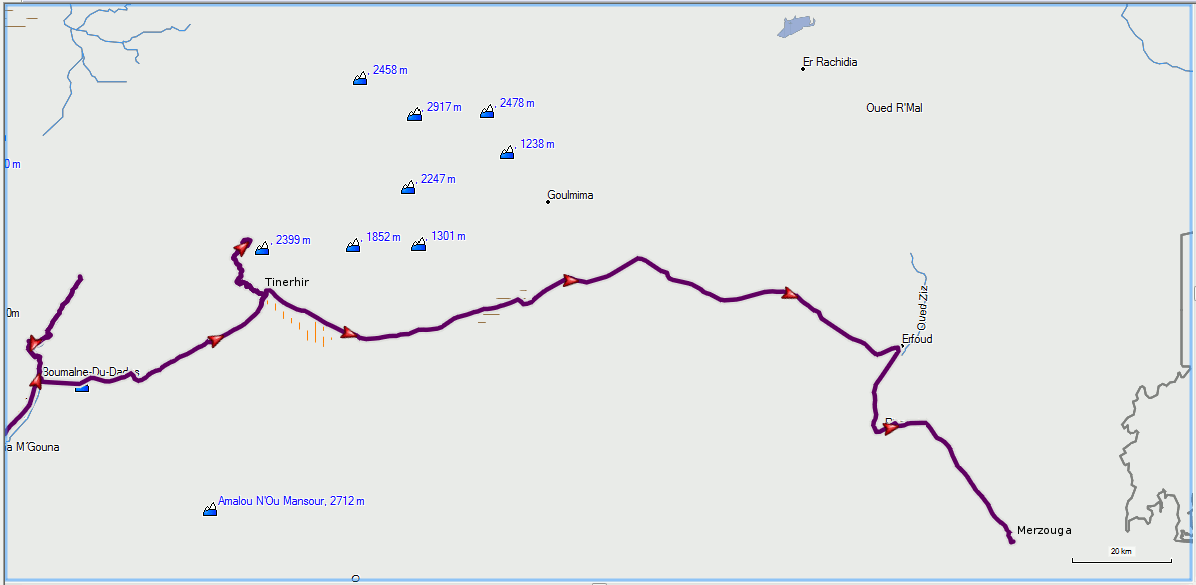
The Journey Blog Bit

We've been carefully saving our track files from the satnav almost since we first set off, but have only just worked out a way to display them on a map.


Our first route inland from Sidi Ifni was through the Anti-Atlas from Tiznit to Tafraoute. Our campsite at Tafraoute amply rewarded us for venturing away from the warmth of the coast. We arrived just as the sun was beginning to set and were surrounded by the most beautiful red rocks glowing in the evening sun.


Next day we had a walk into the surrounding countryside and were struck by how like parts of the American west the landscape was (it reminded us of places in Utah and Arizona), yet how different the towns and villages are here.

From Tafraoute we looped back almost to Agadir, then took the road east; a flat easy drive through the orchards of the Sous valley. At Taroudant we spent the night free of charge in a lay-by full of European motorhomes just outside the impressive city walls.  It was Saturday night and in the main city square the locals were enjoying dramatic performances, music and lectures, almost like a small town version of Djema El Fna.

Next stop was Taliouine (in the saffron producing region of Morocco) and then we were into the stony desert, relieved by narrow ribbons of greenery wherever the rivers broke to the surface drawing people, agriculture and trade.

From Ait Benhaddou we took a trip into the snows of the High Atlas, to Telouèt and the palatial summer residence of the Glaoui Pasha. 


Heading further east we visited Ouarzazate, which was built as an outpost of the French colonial airmail service, today it's the place to go if you're in the desert and need a cashpoint.  In the stunning Gorges du Dadès the river cuts such a deep and narrow channel through the mountain it's hard to believe it's not flowing the other way.  Our campsite 'Berbere de la Montagne' must be very popular in the heat of the summer, as it's 1700m up in the cool of the mountains shaded by the walls of the canyon.  In January that can make for a chilly night. 


Here in the beautiful Gorge du Todra, however, we're a few hundred metres lower and warmer, parked under a date palm on the banks of the clear bubbling river, where tiny birds are darting out to catch insects on the wing.


The Rocks Blog Bit

This part of the world must be especially thrilling for geologists, mineralogists and those who can make sense of this astounding landscape. 

It's a complicated scene; there seems to have been a lot of volcanic activity in the past, and the tectonic movements of Africa drifting into Spain have brought a lot of layers to the surface.  In addition to that, it's a dry country.  There's no cloak of vegetation so the geology is left naked for all to see.


As you drive through the desert the colours and shapes of the rocks are continually changing from red, to green, to grey with orange stripes, from bulbous lava lamp blobs to smooth cones, John Wayne table mountains, jagged plates or toothy spikes.  Some hills look burned like industrial slag, some glisten like coal and some look as soft as a heap of pillows.  We've had to be resolute to keep the photos down to a reasonable number.  With all these layers come all sorts of minerals.  We've passed a salt mine and a silver mine, we've been offered trilobites and ammonites, quartz geodes and cobalt crystals.


The Kasbahs Bit

Southern Morocco is incredibly rich in kasbahs (castles belonging to one family) and ksars (fortified villages).  Most of the old buildings are built from rammed earth, with beams of unsawn wood supporting floors, flat roofs and staircases made of bamboo-like reeds and more mud.  The faces of the towers are often decorated with elaborate carved designs.  It's amazing what you can build with mud and wood – towers, arches, and three storey buildings. 


We had a good look around a couple of particularly spectacular kasbahs in Telouèt  and Ait Benhaddou, and in Skoura we camped beside the kasbah that's featured on Morocco's 50 dirham note. The one at Ait Benhaddou was used as a film set for various productions such as Gladiator, Lawrence of Arabia and Jesus of Nazareth, so the restoration is a bit odd, being partly directed by  Hollywood, partly by UNESCO.


The reason for all these fortifications is, of course, that this used to be a very lawless and violent place.  Anyone who had anything worth nicking needed a fort to keep it in.  The twentieth century brought peace and magistrates, and also concrete.  Most of the old mud ksars and kasbahs are abandoned and gradually dissolving like abandoned sandcastles. 
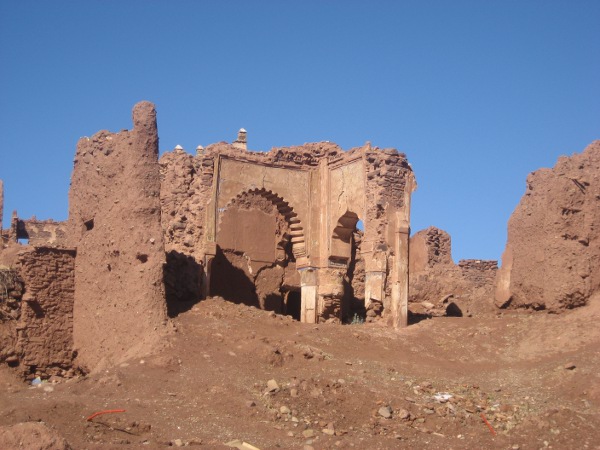


The speed of the collapse is a reminder of how recently these buildings were needed.  They look mediaeval and in some ways they are, but the Glaui Kasbah in Telouèt for example was only built in the 1940s.  The King of Morocco was still collecting revenue from his southern provinces by means of armed cavalry raids in 1913. We walked around an abandoned ksar in the palmery yesterday, and failed to spot anything which would give us a clue as to whether it dated back a century or five centuries.


Other Impressions

There's a lot of space here, but a lot of it is very little use to anyone.  The desert is scattered with springs and river valleys, and that's where the people are.  Everywhere where there is water there are date palms, tiny irrigated fields of wheat and beans, an abandoned red mud town, a kasbah or two and rows of new concrete houses, flats and shops.

Towns are a fairly new idea in this area.  The typical southern town is a wide dirt street with a strip of tarmac down the middle, lined with shops selling gas bottles, water and bits of sheep, and workshops making beds and doors and fixing bikes. For vegetables other than onions and potatoes you generally need to wait for market day.

We had lunch at Chez Dimitri in Ouarzazate.  The front page of the menu boasted that Dimitri's was founded the same year as the town – 1928.  The old photos looked like old photos from Queensland.  The French needed a base to support the air mail service to their African colonies, and of course a decent restaurant that does salade de chèvre chaud, brochettes and crème brulée.

Away from the coast we're into Berber country.  It seems that most Moroccans have mainly Berber ancestry but many, particularly in the old towns and on the coast, feel themselves to be more Arab.  Berber culture and language has tended to be looked down on and even suppressed, but things have been changing since the current king took the throne.  The language was recently given official status alongside French and Arabic, there are some Berber programmes on television and the Berber alphabet can now be used in public.

It's far from clear who is more Berber and who is more Arab, but we've noticed a few changes as we've headed inland.  Berber men still wear jelabayas but often of a plain colour rather than stripes.  Many wear big turbans which can cover their faces against the dust. 

More of the women wear dresses and loose scarves, rather than the gowns and nun-like headscarves of the coast.  Dress patterns seem to vary from area to area, but are often black with red and white embroidery.  Berbers like to swap things – if you make it clear you're not going to buy their produce they'll ask if you'd like it in exchange for some of your clothes, your rucksack or an old mobile phone.

People seem more friendly and less pushy.  We've met people who genuinely seem to want to chat and be welcoming and don't expect to be paid for it.  In  Telouèt our guide to the kasbah, Rachid, and his friend Mohammed were so courteous and laid-back that we ended up spending some of our Christmas money on a Berber rug from the women's co-operative. They were so pleased that they gave us a necklace and key ring as a present. It's not like Marrakesh here.


The Wine Blog Bit

Suspended due to Islam.

Where Next?

Today we're enjoying the greenery and the river, and had lunch overlooking a pool full of sacred fish.

We're a bit kasbahed out and are looking forward to heading even further east to the Saharan sand dunes of Erg Chebbi, where we may even ride on a camel.