Tuesday, 23 November 2010

Ebro Valley and the first significant foul-up

We headed down the Ebro towards Zaragoza, to see what this part of Spain was like and to get to one of the few places in Spain where we can fill up the gas cylinder that we use for heat and cooking.

Just one more wine post:
As we passed through stone outcrops in southern Rioja and Zaragoza province, we noticed lots of chambers excavated into cliff faces.  At a little place called Quel, we found out what at least some of them are. 

Many of the families of Quel, as in other towns in the area, own underground bodegas. They've burrowed into the cliffs to make caves where there is a constant, moderate temperature suitable for making and maturing wine. At Quel the bodegas are excavated into a hillside on the opposite side of the river to the town.  The hillside is studded with doorways like a Hobbit village, and small brick sheds cluster on the hilltop.  In Quel they drop grapes down chutes in the sheds into the underground bodegas.  All the equipment and apace for maturing wine is inside.  The Quel bodegas are being mapped and restored so there were interpretation boards (but no bodega open to view).  Many looked abandoned, but everywhere we went there was a strong smell of wine.

The other good find in Quel was a coin operated public weighbridge (bascula municipal).  We put 50 cents in the slot and got a printed ticket to confirm we're legal: 3.33 tonnes.  That means we can buy 170 kgs of wine and ham.  At that moment it started pouring with rain.  Good timing – we set off to find a spot to spend the night.

It wasn't easy.  We tried a few unsuitable places then started to follow signs for Parque Bardenas Reales, a biosphere reserve, hoping to find a visitors' centre carpark or similar.  It was raining really heavily.  Bardenas Reales turned out to be a barren treeless expanse of rough grazing looking (as far as we could see in the dusk) like Welsh uplands.  It was getting dark so pulled off the road into a layby.  We saw a lane running down into the valley and thought it was worth a quick look in case there was a more sheltered spot.  The van started slipping, the ABS kicked in, the lane looked rough.  Not promising, best not go too far.  We'd already gone too far.  Tried backing out but couldn't see well enough to keep on the track, so tried a 3 point turn ... wheels spun.  Stuck!  It was almost dark now, there were not even any bushes to cut and shove under the wheels, and even if we got moving on branches we had 200m of greasy lane to negotiate.  Hopeless.  Van leaning over badly.  Pelting rain.


We no longer any choice about where to camp for the night, so we settled in and spent the evening checking our recovery policy, looking up 'stuck in the mud' in the Spanish dictionary and generally planning our escape and trying to keep the mud out of the van. (Scooby went out just before bedtime and came back with his feet caked in mud – big clods of sticky clay between his toes; not so easy to keep the van clean!)

The following day started cold but dry, and soon warmed up.  The place looked much more attractive in the strong sunshine.  We started to implement our recovery plan; had breakfast, packed up, found the towing eye and R walked up to the main road to find a milepost to say how far we were from Tudela.

Just before phoning for help, we decided to have one more go at driving out as the sun had dried the clay a little.  We put stones under the front wheels, rocked the van out of its mud hole and got facing in the right direction.  Good, at least that will make the tow easier. Tried to get moving up the hill but slipped, then got some traction on the stubble of someone's crop, got some momentum, turned and got moving on the lane!  Hearts in mouths, we got up the lane slipping all the way and miraculously popped out onto the firm tarmac of the main road.  We set off triumphantly back towards Tudela, with blocks of hard clay flying off our wheels and shattering on the road.

After that we fled to Zaragoza's immaculate new municipal campsite where we spent hours washing towels, mats, the van and ourselves to get back into reasonably respectable condition.

The lessons learned?  Lesson one is that this van is really really bad in slippery conditions.  You can't get away with taking liberties like you can with our usual small light car.  It feels deceptively like a car on the road, but it's more than twice the weight of our Fiesta.  Lesson two, don't panic.  Time, and the Spanish sunshine saved us in this case without having to call out a camión grua. Lesson three is to make sure you pick your spot for the night while there's still daylight.  That's getting more tricky as the days shorten, but we're certainly taking more care.

A little while after this we headed up into the Pyrenees to visit the beautiful Ordessa y Monte Perdido (the lost mountain) National Park; the scenery was stunning and we were surrounded by snow topped mountains. However, as we headed up, and up towards the car park the road started to get a bit snowy, and slippery, and then more snowy and slippery … Remembering our mudhole experience we turned round and headed back down to warmer ground – we didn't fancy a night spent stuck in the snow!


We have now learned our lesson and bought snow chains for the van. 

Sunday, 7 November 2010

Meeting an old friend for the first time – La Rioja

Maybe it's in my blood.  A few years ago a London trained chef opened a very pretentious restaurant in a seedy part of Swansea.  A few months later, in an interview with a national newspaper, he managed to alienate most of his potential clients by saying how backward Swansea people were and how little taste they had.  He illustrated this by saying that all his customers asked for Rioja; that was the only wine they knew.  I seem to remember he was heading back east down the M4 less than a year later.

Provincials we may be but we've both been enjoying Rioja wines for years; fruity, oaky, they just seem to be our kind of thing.

… and reliable; we seem to stand a good chance of getting something enjoyable even buying blind and not spending a fortune.

… and distinctive; the Rioja red wines are made from 80-90% temperanillo grapes, aged in oak.  That seems to give the wine a character that no-one outside Spain seems to imitate, perhaps because Spain does it so well and cheaply.

… and exceptional.  Some of our most memorable bottles have come from La Rioja.  The white wine we ordered by accident at the Greenhouse (a now defunct Cardiff vegetarian restaurant) that turned out to cost several times more than we expected but to be worth every penny (but was so strong we forgot to note the name).  The affordable  red that even succeeded in impressing Anne Dunstone (a Campo Viejo Gran Reserva, I think).  The red from a tiny unknown bodega that we stumbled across in a pub in Church Stretton then hunted down to a wine merchant in Nottingham (Gustales Crianza from Bodegas Navajas).  The white we thought might have been the same as the one from the Greenhouse that we failed to track down on a trip to Barcelona, only to find it in Cowbridge (Viña Tondonia).

So, something of a pilgrimage, this.  We were very keen to see the place these wines came from, find out something about how they are made, and of course taste a few.

So we've spent a few days exploring La Rioja, and here it is:


It's not big at all. From what I can make out most of the area is a wide alluvial plain between two ranges of stunning mountains.  This photo was taken from San Leon (1228m) near the Puerto de Herrera pass in the mountain range separating La Rioja from the Basque country and Vitoria / Gasteis.  It's looking south across the plain towards the mountains of southern Rioja (not very clear through the haze, but pretty substantial, you can ski there).  Logronio is off to your left, Haro to the right, Laguardia straight ahead.  This plain includes two of La Rioja's three regions; Rioja Alta and Rioja Alavesa.  The third, Rioja Baja, is out of sight to the left and known more for vegetable growing than wine.

The standard story is that Bordeaux wine makers whose vines were failing due to the Phyloxera epidemic brought their know-how to Rioja which continues to make wine using the original nineteenth century Bordeaux methods.  In fact, both areas have changed and diverged over the years.  The differences are very interesting:
  • In Bordeaux everything has to be done in the Chateau; the Chateau's own grapes are crushed, fermented, pressed, matured and bottled on site.  In Rioja the bodegas seem to have much more freedom to move things around and blend wines from different areas.
  • Riojan wine makers are very proud that they still mature all their wine in Bordeaux barriques. No-one seems to have told them that for the last three years Bordeaux has been allowed to use oak shavings instead of maturing in barrels.
  • Different grapes of course.  Mostly Merlot in one half of Bordeaux, mostly Cabernet Sauvignon on the Medoc side of Bordeaux, mostly Temperanillo in Rioja.
  • Different cultivation of the grapes.  Half the parcels of Riojan vines seem to be growing with no support at all, and are pruned back to a gnarly stump every winter.  In Bordeaux they are pruned to an elegant 'T' shape with their arms strapped to taught steel wires.
  • Related to that, much more hand picking in La Rioja.  We missed the harvest but we're told half the vines are still hand picked.  Certainly a lot of the vines we've seen, unsupported and with long straggly side shoots and bushy tops, would have been torn apart if they'd been machine harvested.
It's a shame we missed the harvest, but we were busy seeing interesting things elsewhere.  The current state of the 2010 wine is that it's completed alcoholic fermentation and the bodegas are separating the wine from the solid remains of the grapes.  There are purple heaps of freshly pressed grape skins in all the yards.  Next comes several months of malo-lactic fermentation before the ageing process begins.

Still, this has been a great time of year to visit if only because of the spectacular colours of the vines in autumn. The Riojan tourist authority could really make a big deal of this if they wanted to, like New England in the fall or cherry blossom time in Hokkaido.  Every parcel of vines seems to be a different colour and every colour seems hand picked to complement its neighbour.  This photo was taken from the Dinastia Vivanco wine museum near Haro:


We found Bodegas Navajas' wines were for sale in reception at our campsite in Navarette.  We popped round the corner to the bodega and bought a few bottles.  A small place, very much a farmyard and a factory, not at all geared up for visitors (many crazed snarling Alsatians in the yard), but happy to chat.  Apparently 2010 is going to be good, maybe excellent (but I suppose he would say that.  The official Consejo Regulador de la Denominación de Origen Calificada Rioja chart of vintages shows every year since 1972 has been above average).

At the other extreme are places like Bodega Ysios, a contemporary temple to wine:


Current location: back in the excellent campsite in Navarette.

Coming soon, a post that's not about wine.  Promise!

Monday, 1 November 2010

Bordeaux to Basque Country

Sand, sea, a happy dog.

I thought Rhosilli was an amazing long sandy beach, two miles of uninterrupted sand from Worms Head to the Loughor estuary.

I thought the series of beaches stretching west from the Ogmore estuary were quite something; Newton Beach, a few rocks then Trecco Bay, Rest Bay, a few more rocks at Sker Point then Kenfig Sands, the Kenfig River then Morfa Sands, the Afon Afan then Aberafan Beach, Crymlyn Burrows and the sweep of Swansea Bay round to where the sand peters out in the mud of Mumbles Roads and the rocks of Mumbles Head.   At least twenty miles of sandy beaches, uninterrupted apart from a few rocky headlands, estuaries and the Corus Steelworks deep water harbour.

The Côte d'Argent made all that seem a bit inadequate.  The name was coined by a group of journalists who travelled up the coast early in the 20th century, then picked up by the local authorities as a marketing tool.  The journalists said the sands stretched uninterrupted from Biarritz to Cap Ferret.  Actually, on the northern side of Cap Ferret they continue at least to Soulac on the tip of the Médoc.  It must be one hundred and fifty miles at least.


We stumbled onto it at Lacanau Océan; an immaculate strip of fine squeaking sand backed by towering dunes.  Inland from the dunes, a forest of 'Pine Maritime'.  Seaward from the sand, a steeply sloping waterline where Atlantic waves thunder endlessly, then the vast blue ocean.

Out of season a few surfers hang on.  You see them in their hand painted vans with towels pinned across the windows, parked up in odd corners.  Out of season no-one seems to mind.  Sometimes we even saw them in the water.  The surf isn't always up to scratch, but when the wind's in the right direction there's a huge reach and big deep-ocean waves.  The hairdressers in Lacanau had a sign 'Last hairdressers before America.  Next haircut Miami 6,000 km”.

We kept visiting other coastal towns to see if the beach had run out yet; Carcans, Biscarrosse, Mimizan, Soustans, all the same story.  Every morning we were stunned by the beautiful beaches (we got a lot of very similar photographs), and every morning Scooby went wild with delight digging, swimming and chasing  his ball (it almost killed the poor old fellow), but to be honest, it got a bit samey.  Walk out of sight of the resort town and you couldn't tell where you were.  Even within site of the resort town, they all look pretty much alike, especially in autumn; a shuttered surf shop, a bar, a seafood restaurant and a waffle stall.

But this incredible stretch of uniformly beautiful sand helps satiate the French population's love of seaside summer holidays.  Near Arcachon we got lost looking for a free campsite and drove for miles alongside the fence line of a deserted summer holiday camp.  This area must be able to absorb millions of people; every Frenchman and woman who can get time off work, plus a fair number of northern Europeans who are in on the secret.  There's space enough even for the unsociable and the naturists to wander a few hundred metres from the boardwalk and find a stretch of sand they can have to themselves.

So in the dark days of Word War 2 this must have been the dream posting:


“Liebe Mütti” (the Atlantic coast was occupied by Germany from 1940) “They said we were going to be sent to the eastern front to support the attack on Stalingrad, but there was a last minute change of plans and they've ordered us to guard this beach instead.  It's three days sailing from England, two weeks sailing from America and far out of range of the RAF, so I'm not expecting much action.  Please send me some Blutwürst and my swimming trunks, tell Granny I don't need any more mittens.”

The strandline is also amazingly clean, apart from these things:


Anyone know what they are?  There are millions of them.  Some of them look like pasta shapes, but they're definitely not edible.

Basque Country

A strange sense of homecoming.  After weeks in Bordeaux and the flat sandy plain of Landes, we were suddenly climbing through lush green hills on a winding road lined with oak trees.  The hills were draped with fields in which sheep and cattle grazed.  Even the road signs were in two languages (with one of the languages obliterated with aerosol paint).

It was great to have some topography again.  Even the mist was comforting.  The old farmers here wear berets like those of Carmarthenshire wear flat caps (the British think of berets as typically French. The French think of berets as typically Basque.  The Basques think of berets as typically Basque, and they really do wear them).

Some things are very different to home.  We climbed a steep slippery path through a sodden oak wood (more sweet chestnut trees than I'm used to, but generally pretty familiar), emerging on a rutted track, separated from the adjacent field by a wonky barbed wire fence.  So far so familiar, but the field was filled with neat rows of chilli plants (Piment d'Espelette, maybe more on that later), thriving  under the grey sky.  It was quite a jolt of unfamiliarity to see the perfect red fruits ripening there in the open air.

This blog is lagging badly behind events.  We're still in the Basque country, but on what the Basque nationalists call the southern Basque country and the Spanish nationalists call Spain.  We're currently (31 October) parked up  in Victoria / Gasteis watching Spanish telly and listening to the rain.

Monday, 18 October 2010

Bordeaux vendage up close

I (Richard) have been getting my hands dirty (purple) with the Bordeaux grape harvest – a fascinating experience.  The work was at Château Rousselle, a producer in the Cotes de Bourg area not far from Blaye, which we'd visited during our previous trip in 2007.  The proprietor, Vincent Lemaitre, has run the château for just over a decade so is a relative newcomer and not embedded in the traditions as some of his neighbours are. 

Wine making in Bordeaux is heavily regulated;  the grape varieties are specified (predominantly Merlot, Malbec and Cabernet Sauvignon), the yield per hectare is limited, the areas which can be cultivated are limited by law.  The Bordeaux authorities have traditionally been very cautious about accepting changes which they feel might threaten the area's distinctiveness and its good reputation.   Within these constraints Vincent aims to make a great wine at a realistic price, and  is happy to use the latest technical and scientific tools to help him do this.

The first day (6 October) was a bit awkward.  Everything was arranged for the harvest, the regular team was in place and there was plenty to do.  The last thing they really needed was a clueless visitor with poor French trying to help out, but they had agreed to let me join the team as a favour.

The team was harvesting a parcel of old vines some way from the château.  The grape harvesting machine stands high, like a tall spindly legged tractor, straddling the row of vines.  As it proceeds down the row, grapes are stripped from their bunches, the vines thrash about and broken leaves whirl into the air.  It's not a gentle process but it's quick, so the grapes can be picked and used in peak condition.  The job this morning was to follow the machine and pick any of the precious old vine grapes that had been left behind by the machine.

Old grape vines are a mixed blessing; the juice they produce has a richer and more concentrated flavour but yields are low and the vines are thick and brittle.  The harvesting machines are quite rough with the vines, so old vines often need special care and sometimes hand picking. 

At mid-day we all returned to the château for lunch; baguettes, cheese and ham washed down with Château Rousselle 2008.  From the first sip it seemed surreal to drink such a good wine to accompany a hurried working picnic lunch.

I spent the afternoon on the sorting table – a conveyor belt from which any remaining leaves and stalks are picked out by hand before the grapes are crushed.  At the end of the day, after cleaning all the equipment, Vincent agreed to meet me on Saturday morning to show me the work that goes on in the cellar to make the wine and show me how different it is from the traditional image of Bordeaux wine making.

Over the weekend I was, fortunately, able to make myself more useful.  All the regular staff, who had been harvesting all week, had taken the weekend off, and Vincent was planning to work alone, apart from a brief visit from his flamboyant wine making advisor Olivier.

Olivier's visit changed everyone's plans for the weekend. The 2010 vintage, he said, is a vintage for the worker, not the lazy man.  The hot dry summer has produced a concentrated juice which is going to ferment quickly into an unusually strong wine (14.5%).  When the alcohol levels get too high it is no longer possible to extract the desirable compounds from the grape skins, so extra effort early on will show in the finished wine.

He advised Vincent to empty the juice out of every vat each day, leaving the floating cap of grape skins and pips behind, then to pump it back on top of the skins as quickly as possible, so that the cap is broken up and mixed, and as much colour and flavour as possible extracted from the skins.

So on Saturday and Sunday the two of us spent hours elbow deep in grape juice clearing strainers,  dragging hoses, hauling buckets of grape skins up ladders, cleaning equipment and taking care not to spill a precious drop (yields are down this year, after a dry summer).

Anyone who's tried wine making at home would be surprised by how this process works.  You don't need to be gentle with this stuff.  While everything was kept clean, there's no need to sterilise equipment or protect the fermenting juice from the air.  This is not like coaxing a reluctant demijohn of blackberries into fermentation.  This yeast is is feisty stuff, eager to devour the juice.  A big part of the wine maker's job is to try to slow down the alcoholic fermentation, so that more subtle flavours can develop.  The tops of the vats are open to the air, but as you peer into them from the top of the ladder you're faced with an eye-watering blast of alcohol and concentrated grape flavours.    This yeast is more than a match for any bacteria that might drop in wanting to make vinegar; the vapours were more like what I would have expected from new brandy than from wine.

In other ways it's delicate and subtle.  The difference between an OK wine and a great one comes from effort and attention to detail; nursing those tired old vines through another harvest, picking out those bitter green stalks, extra extraction on a Saturday afternoon when your staff are resting.

Every day Vincent records the specific gravity and temperature of the juice, and tastes it.  Every day the SG drops as the sugar is fermented away, and it's a constant struggle to keep the temperature under control to balance the heat of the fermentation.  Every day the flavour of each vat changes; from cloyingly sweet to rich and jammy to something starting to resemble wine.

On the Sunday evening I left Château Rousselle to its work, with a box of six bottles to accompany us on our journeys.  Over the next week the remaining vats will be filled, and within a couple of weeks will have reached their full alcoholic strength.  After that, the juice will be transferred to concrete vats for a quieter few weeks, during which it will undergo the mysterious process of malo-lactic fermentation.  After that comes months of further maturation, some of it in French oak barrels, some of it in American oak, and finally bottling and sale. 

Berry Bros & Rudd sell Château Rousselle in the UK.  If I can possibly scrape together £20 on my return, I'll be buying at least one bottle of Château Rousselle 2010.  I was there at the beginning and I have to find out how this story ends.

After that we headed across the Gironde to the Médoc and its astonishing sandy beaches.  Since then we have been making our way slowly south down the west coast towards the Spanish border.

Wednesday, 29 September 2010

Blogging as it should be done?

Since we're staying on a luxurious campsite (Camping Le Capeyrou, Beynac) with wifi on tap, we can tell it as it happens.  Tomorrow we head back to the kiwi farm, where there's no wifi on tap (or even a tap) so we may go quiet again for a while.  The staff at Le Capeyrou have spent today cleaning the furniture on the terrace, ready to pack up for the winter, they close tomorrow.  Finding campsites is going to become more and more difficult.

We woke today to chilly mist, which was gradually burnt off by the sun, the temperature rising rapidly until Scooby was sitting melting in a sunbeam, his favourite thing.  The castle on the crag overlooking the site suddenly appeared in the middle of the sky, very dramatically.  I'm not used to my horizons being that far above me.

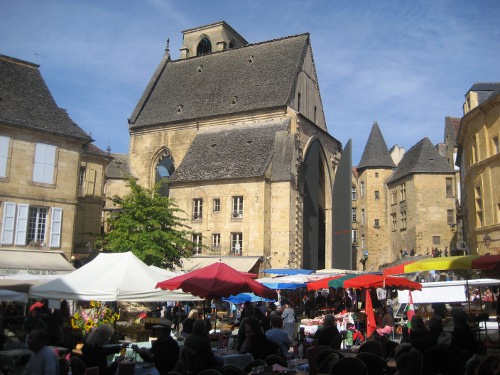
We drove into Sarlat for market day.  It is a fabulous old mediaeval city and a fabulous market, with lots of Perigord duck and goose products, truffles and walnuts, but also proper gnarly vegetables and good fish.  We bought a chunk of pumpkin and some other veg, then miscalculated and spent a fortune on a block of cheese.  Half the voices in the market were English or American, this region is something of a theme park.

Caught up on chores, did some washing, took advantage of the wifi to do some emailing, some administration and finally submit my tax return.  Unfortunately, the day we have wifi is the day when the least interesting stuff happens!

Tuesday, 28 September 2010

Further south ... red wine country

Real trouble keeping up with the blog … technology has been getting in the way and things keep happening!  To have any chance of catching up we'll have to skip over our meander down through the Vendee and Charente, and jump straight to Blaye.

In 2007 we'd made our second, more determined attempt to get to Bordeaux and find out what all the fuss was about.  By a happy accident we stayed in the Villa Saint Simon in Blaye – where we had a fantastic welcome from the oenophile South African proprietor, Les Kellen.  He introduced us to his favourite local chateaux, the sort of places that make the wine that the region is famous for, at a reasonable price (and which seems to all be swallowed up by the domestic French market, leaving the dross and the £40 clarets for the Brits, who naturally turn to the Hunter Valley instead).

Blaye is a small town dominated by a spectacular seventeenth century fort, built by the famous (in France anyway) military architect Vauban on the orders of King Louis the Fourteenth.  It was intended to keep the British out, but these days everyone is welcome to squeeze in through a series of granite gateways and stay on the municipal campsite right inside the battlements.


Big, beautiful, blue, but not too big, not quite

We arrived on 20th, and once we'd checked in and found ourselves a plot with a fabulous view over the Gironde estuary we walked back into Blaye to say 'Hi' to Les.  A quick visit became a long evening of drinking wine and catching up with his many projects; wine tours, wine dealing, a new art gallery in the street behind Villa Saint Simon, a share in a vineyard and a derelict kiwi fruit farm which he plans to turn into an eco-resort.

On 22nd we moved to the kiwi farm for a couple of days of solitude next to the lake amongst the overgrown kiwi fruit vines, enjoying the company of the friendly resident geese and the coypu family and reading a MBA thesis on the eco-village project.

On 24th we headed off again to have a look at the Dordogne, making our way to Perigeaux, Brive Le Galliarde and Rocamadour. 

This post does our travels no justice, but is dedicated to everyone to whom we gave promises to tell them what we were doing! To bring it right up to date, it's 28th September and we're having a delicious lunch in the WiFi equipped La Table du Marais restaurant overlooking the lake in Groléjac (Scooby is sleeping underneath the table - when we ask if we can bring him into a restaurant we are usually met with a surprised expression and 'Bien sur, pas de probleme!').

Sunday, 19 September 2010

Pushing south, wine country

13th September 2010
After a couple of days at 'Les Vikings' (a holiday park in Barneville-Cartaret) we headed down the coast towards Granville, where we'd stayed in the hot summer of 2003, and which we remembered fondly.  When we eventually found the aire at Pointe De Roc it was completely full, so we headed off down the coast to find another place to stay.

As we passed the youth hostel by the port we saw a dozen motorhomes parked up in a free carpark, so turned in and joined them.  In addition to the aires and France Passion sites, camping caristes in France also seem to benefit from the French instinct that if something's not expressly forbidden it's allowed, and if it is expressly forbidden it's probably allowed anyway, or ought to be.

We settled in, filled up with water from the free tap and walked to the port to eat on the terrace at La Phare, where we'd eaten last time.  In the morning, as we returned from another trip into town to buy fish, we met the Police Municipal whowere going from van to van politely asking people to move on.  They'd even been considerate enough to leave it until almost mid day to start the evictions.

14th September 2010
Leaving Granville a little damp and breezy, we set off for a 180km push south on the autoroutes, looking for the sun.  As we approached Nantes we saw fields of sunflowers and vineyards for the first time, the sun began to shine strongly and there was a  real feeling of having crossed a threshold.  This felt like The South.

Tonight's stop was another France Passion site, the Domaine de la Pichonière in Haute Goulaine, where the vendage was in full swing.  Here Isabelle and Michel Olivier grow muscadet and gamay grapes which go to make the muscadet sur lie that the area is best known for, but also, red, rosé and mousseux wine.

The vendage was in full swing, with trailer loads of grapes pulling into the farmyard.  The grape presses were throbbing and the air was heavy with the sweet syrupy smell of fermenting fruit.  Inspite of all the activity Mme Olivier took the time to welcome us and led us on her bike to a plot of grass at the front of the house where we could camp.  Once we'd settled in, she showed us her products and treated us to some generous samples.  Inevitably we left with our arms full.

 At the far end of the vineyard top-heavy tractors, tall and spindly like Salvador Dali elephants, were harvesting the grapes which hung in full heavy bunches on the vines. 

Back in the camping car we filleted and fried our Granville gurnard with boiled potatoes and green beans, and ate outside in the  late evening sunshine.