Sunday, 29 January 2012

Sun, sand and snow

Severe weather warning for south east Wales :
“Rain pushing in from the west is expected turn to snow on the leading edge, with the potential for accumulations of several cm, especially on hills. For Wales and SW England the snow is expected to begin on Sunday, whilst further east it will begin on Monday morning. The public are advised to be aware of the potential for disruption to traffic.”

For once we're not saying 'Poor them' and congratulating ourselves for being well out of it. We're in Azrou in the Atlas mountains and we've got snow too.


From Merzouga we drove north through stony desert and over the High Atlas range at its lower eastern end.  As we climbed into the Middle Atlas on Friday (27th Jan) we could see dark clouds ahead and approaching cars with wet snow on their number plates.  The landscape suddenly became wetter, we saw green trees and sodden meadows, snow lying in shady spots and lots of muddy farm dogs.  For a moment it was like coming home.


We got settled into our campsite at Azrou, got cosy and watched the snow fall in big flakes.  The next day as the ploughs and gritters reopened the mountain road we retraced our steps into the cedar forests just south to join the locals enjoying the weekend winter wonderland.


The cedars of the Middle Atlas produce the timber of choice for palace doors and ceilings, which we've come across repeatedly. After so much desert, they are a refreshing change of scenery.


This forest is home to some friendly bands of Barbary Apes, a popular tourist attraction for visitors and Moroccans alike. 


While the road was open and well gritted, some vehicles were struggling so there were a lot of hold ups.  Most of the people in the queues seemed pretty patient and content to wait, take photos of each other on mobile phones, have snowball fights and give bread to the monkeys (we'd responsibly brought them some apple and banana, which was also popular).


Johnny Monkey Eats Bread:


In the afternoon we took a loop through Mischlifen, which was marked on the Michelin map (and signposted from Ifrane) as a ski resort.  When we finally found it, it was clear that building a ski hotel must have been one of the last things the French did before Morocco won its independence.


The local entrepreneurs were out in force here, as they were all over the mountains, giving horse rides, selling sweets and drinks, renting out skis and home made sledges. 


What they weren't able to do was get the ski tows working (they've not worked for years, people seemed surprised at the very idea).  Any attempt to ski would have meant trudging up the hill then skiing down into a dense throng of tobogganers and picnickers so we decided to give it a miss.

Next week we're planning to visit three interesting cities grouped closely together; Fez, Meknes and Moulay Idris.  After that, there's only the Rif mountain range remaining between us and the ferry back to Europe.

Thursday, 26 January 2012

Sand, sun and an ancient sea


Current location Camping La Tradition, Merzouga, at the foot of Erg Chebbi. 


Our back wheels are parked as far onto the sand as we dare, and we can gaze (or walk) straight out into the spectacular dune system.


We've had a busy day!

We started off with a Landrover trip around to the southern and eastern side of the dunes, looking east into Algeria, visiting two tiny mines, a hill that seemed to be made of ammonite fossils, an abandoned mining village and the fringes of the sand. 

The ammonite hill must have been deposited on the bed of a prehistoric ocean, and that ocean must have been absolutely swarming with ammonites.


The trip was very interesting, and we're glad we didn't attempt it in the van, but we came back with more fossils than we knew what to do with and had to leave some at the campsite.

This afternoon we took a short trip out into the dunes on camel back, along with Morag and Janice from Norfolk.  Camels are strange, strange but very useful animals.  Very grumpy while they're being saddled up, but perfectly well behaved when under way. They have fabulous feet and the most luscious, long eyelashes; perfectly evolved for the desert. We enjoyed the ride but wouldn't want to go to Timbuktu on one – an hour is enough to give you a slight John Wayne walk.


(Thanks to David Fossey for the photo)
www.travelblog.org/Bloggers/Grey-haired-nomads/

And now it's dusk, time for some more prayers if you're that way inclined, another tagine and another display of brilliant stars.


(Blog entry written on 24th January, published a few days later due to understandably poor internet access)


Addendum

On our way east we'd hurried past rows of strange structures in the desert – hollow cones of mud like little volcanoes about four metres tall.  After we left Merzouga we retraced our steps a few kilometres to have a closer look.


They turned out to be the visible bits of a 'khettara'.  These are long horizontal tunnels which act as combined wells and pipelines, collecting groundwater and channelling it to the fields for irrigation.  Every ten metres or so there's a vertical shaft to the surface to provide ventilation for people working on the tunnels and allow access to draw water.  The shafts are topped with a cone of soil, presumably to prevent too much sand from blowing into the tunnel.

About half the khettaras in this area have dried up in recent decades, possibly due to changes to the local hydrology caused by a dam.  In any case, these days it is much easier to sink a tube well and pump water through a pipeline.  When they were built centuries ago they must have been a huge undertaking.

We ended up in a tent / shop / tearoom / hotel / visitors' centre (N31 31.449 E04 29.312) run by three brothers who have excavated a narrow set of stairs down through the rock into the old channels so visitors can see them from the inside (50 dirham, probably negotiable for groups).  At this point the tunnel is probably six metres down and two or three metres in diameter, with a hard rock ceiling, bone dry with heaps of drifting sand.


They asked me to mention them and their business. They will also provide accommodation in a nomad tent, custom tours and entertainment by arrangement.  They can speak Arabic, Berber, French, English and who knows what else? More detail at www.abdultours.com.

OK lads?

Saturday, 21 January 2012

Rocks and Kasbahs


As we travelled down the coast of Morocco, we were taking advice from a couple of guidebooks we'd downloaded for the Kindle and from previous visitors' blogs.  One of the blogs had made a comment “sticking to the coast doesn’t really do Morocco any justice at all”.  We'd been having a great time and seen some fascinating places, so that left us wondering what marvels were waiting in the mountains.

The Journey Blog Bit

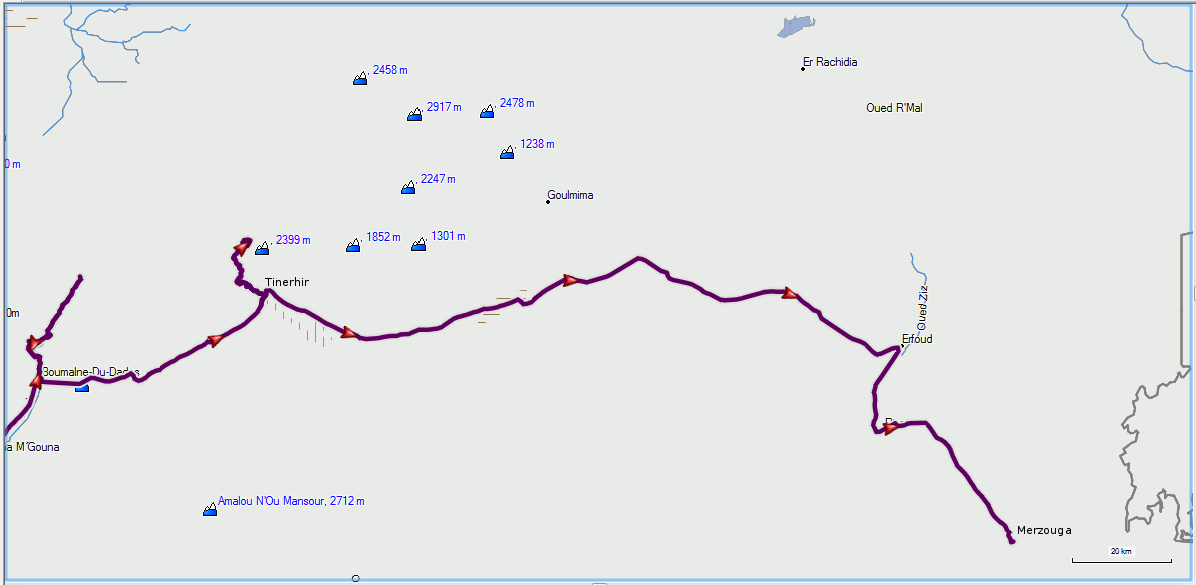
We've been carefully saving our track files from the satnav almost since we first set off, but have only just worked out a way to display them on a map.


Our first route inland from Sidi Ifni was through the Anti-Atlas from Tiznit to Tafraoute. Our campsite at Tafraoute amply rewarded us for venturing away from the warmth of the coast. We arrived just as the sun was beginning to set and were surrounded by the most beautiful red rocks glowing in the evening sun.


Next day we had a walk into the surrounding countryside and were struck by how like parts of the American west the landscape was (it reminded us of places in Utah and Arizona), yet how different the towns and villages are here.

From Tafraoute we looped back almost to Agadir, then took the road east; a flat easy drive through the orchards of the Sous valley. At Taroudant we spent the night free of charge in a lay-by full of European motorhomes just outside the impressive city walls.  It was Saturday night and in the main city square the locals were enjoying dramatic performances, music and lectures, almost like a small town version of Djema El Fna.

Next stop was Taliouine (in the saffron producing region of Morocco) and then we were into the stony desert, relieved by narrow ribbons of greenery wherever the rivers broke to the surface drawing people, agriculture and trade.

From Ait Benhaddou we took a trip into the snows of the High Atlas, to Telouèt and the palatial summer residence of the Glaoui Pasha. 


Heading further east we visited Ouarzazate, which was built as an outpost of the French colonial airmail service, today it's the place to go if you're in the desert and need a cashpoint.  In the stunning Gorges du Dadès the river cuts such a deep and narrow channel through the mountain it's hard to believe it's not flowing the other way.  Our campsite 'Berbere de la Montagne' must be very popular in the heat of the summer, as it's 1700m up in the cool of the mountains shaded by the walls of the canyon.  In January that can make for a chilly night. 


Here in the beautiful Gorge du Todra, however, we're a few hundred metres lower and warmer, parked under a date palm on the banks of the clear bubbling river, where tiny birds are darting out to catch insects on the wing.


The Rocks Blog Bit

This part of the world must be especially thrilling for geologists, mineralogists and those who can make sense of this astounding landscape. 

It's a complicated scene; there seems to have been a lot of volcanic activity in the past, and the tectonic movements of Africa drifting into Spain have brought a lot of layers to the surface.  In addition to that, it's a dry country.  There's no cloak of vegetation so the geology is left naked for all to see.


As you drive through the desert the colours and shapes of the rocks are continually changing from red, to green, to grey with orange stripes, from bulbous lava lamp blobs to smooth cones, John Wayne table mountains, jagged plates or toothy spikes.  Some hills look burned like industrial slag, some glisten like coal and some look as soft as a heap of pillows.  We've had to be resolute to keep the photos down to a reasonable number.  With all these layers come all sorts of minerals.  We've passed a salt mine and a silver mine, we've been offered trilobites and ammonites, quartz geodes and cobalt crystals.


The Kasbahs Bit

Southern Morocco is incredibly rich in kasbahs (castles belonging to one family) and ksars (fortified villages).  Most of the old buildings are built from rammed earth, with beams of unsawn wood supporting floors, flat roofs and staircases made of bamboo-like reeds and more mud.  The faces of the towers are often decorated with elaborate carved designs.  It's amazing what you can build with mud and wood – towers, arches, and three storey buildings. 


We had a good look around a couple of particularly spectacular kasbahs in Telouèt  and Ait Benhaddou, and in Skoura we camped beside the kasbah that's featured on Morocco's 50 dirham note. The one at Ait Benhaddou was used as a film set for various productions such as Gladiator, Lawrence of Arabia and Jesus of Nazareth, so the restoration is a bit odd, being partly directed by  Hollywood, partly by UNESCO.


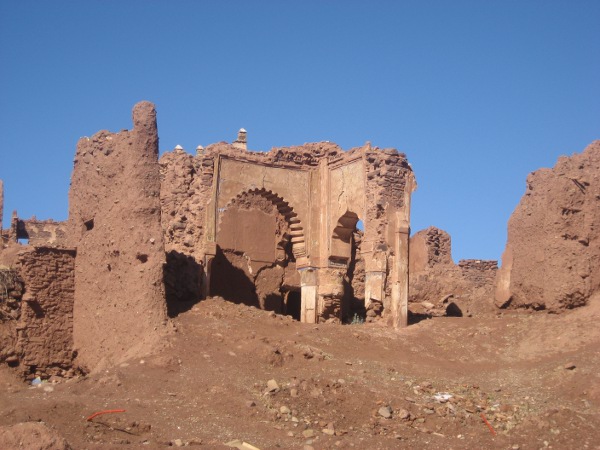
The reason for all these fortifications is, of course, that this used to be a very lawless and violent place.  Anyone who had anything worth nicking needed a fort to keep it in.  The twentieth century brought peace and magistrates, and also concrete.  Most of the old mud ksars and kasbahs are abandoned and gradually dissolving like abandoned sandcastles. 


The speed of the collapse is a reminder of how recently these buildings were needed.  They look mediaeval and in some ways they are, but the Glaui Kasbah in Telouèt for example was only built in the 1940s.  The King of Morocco was still collecting revenue from his southern provinces by means of armed cavalry raids in 1913. We walked around an abandoned ksar in the palmery yesterday, and failed to spot anything which would give us a clue as to whether it dated back a century or five centuries.


Other Impressions

There's a lot of space here, but a lot of it is very little use to anyone.  The desert is scattered with springs and river valleys, and that's where the people are.  Everywhere where there is water there are date palms, tiny irrigated fields of wheat and beans, an abandoned red mud town, a kasbah or two and rows of new concrete houses, flats and shops.

Towns are a fairly new idea in this area.  The typical southern town is a wide dirt street with a strip of tarmac down the middle, lined with shops selling gas bottles, water and bits of sheep, and workshops making beds and doors and fixing bikes. For vegetables other than onions and potatoes you generally need to wait for market day.

We had lunch at Chez Dimitri in Ouarzazate.  The front page of the menu boasted that Dimitri's was founded the same year as the town – 1928.  The old photos looked like old photos from Queensland.  The French needed a base to support the air mail service to their African colonies, and of course a decent restaurant that does salade de chèvre chaud, brochettes and crème brulée.

Away from the coast we're into Berber country.  It seems that most Moroccans have mainly Berber ancestry but many, particularly in the old towns and on the coast, feel themselves to be more Arab.  Berber culture and language has tended to be looked down on and even suppressed, but things have been changing since the current king took the throne.  The language was recently given official status alongside French and Arabic, there are some Berber programmes on television and the Berber alphabet can now be used in public.

It's far from clear who is more Berber and who is more Arab, but we've noticed a few changes as we've headed inland.  Berber men still wear jelabayas but often of a plain colour rather than stripes.  Many wear big turbans which can cover their faces against the dust. 

More of the women wear dresses and loose scarves, rather than the gowns and nun-like headscarves of the coast.  Dress patterns seem to vary from area to area, but are often black with red and white embroidery.  Berbers like to swap things – if you make it clear you're not going to buy their produce they'll ask if you'd like it in exchange for some of your clothes, your rucksack or an old mobile phone.

People seem more friendly and less pushy.  We've met people who genuinely seem to want to chat and be welcoming and don't expect to be paid for it.  In  Telouèt our guide to the kasbah, Rachid, and his friend Mohammed were so courteous and laid-back that we ended up spending some of our Christmas money on a Berber rug from the women's co-operative. They were so pleased that they gave us a necklace and key ring as a present. It's not like Marrakesh here.


The Wine Blog Bit

Suspended due to Islam.

Where Next?

Today we're enjoying the greenery and the river, and had lunch overlooking a pool full of sacred fish.

We're a bit kasbahed out and are looking forward to heading even further east to the Saharan sand dunes of Erg Chebbi, where we may even ride on a camel.

Wednesday, 11 January 2012

Sunshine, snake charmers and sand dunes.

Since our New Year blog we've travelled down the coast to Essaouira, nipped inland for a few days in Marrakesh, and then returned to Essaouira and continued down the coast as far as Sidi Ifni.

On the way down to Essaouira we stopped off for one night at Safi, the centre of Morocco's ceramics industry.  They make everything here, from bricks to roof tiles to fabulous hand painted plates and ewers.  They also make dribbly castles like giant fish tank ornaments, plates with 'Souvenir of Morrocco' written in glitter and Barcelona FC commemorative plates – the full range of everything you can do with baked earth. We couldn't resist buying a little something to remind us of our trip, and ended up buying a large tagine cooking pot and charcoal burner – far too big to carry in the van, but never mind. It'll come in handy if we run out of gas for cooking!


In Europe the local tourist board gets very excited if one of their towns has a surviving section of town wall.  Walled cities like Chester, Carcassonne and Aigues Mortes are automatically big attractions.  In Morocco, the city wall around the old medina goes without saying.  Safi was just one more example, the medina being fully enclosed by a red brick wall, intact from footings to crenelations, and only pierced by a handful of dramatic gateways.


We entered by the port, walked up through the lively souk and emerged on the inland side of the town at the Hill of the Potters.  Red stone is quarried a few kilometres up the road and brought to the Hill of the Potters where it is ground up, soaked in water and puddled into usable clay.  The hill is scattered with ramshackle workshops and the brick chimneys of wood fired kilns. We were shown around the kilns and workshops and met men making pots and also a man with a remarkably steady hand decorating plates.


Further down the coast we spent a few nights at the appropriately named 'Camping Le Calme' near Essaouira, a former Portuguese colonial outpost, now a lovely, laid back fishing port and resort. Essaouira was popular with hippies in the 60s and there are various stories about Jimi Hendrix and Cat Stevens staying here (some possibly true, most works of fiction). It still attracts Europeans of a hippy persuasion, but due to its huge sandy beach and breezy climate it's also a very popular holiday resort for Moroccans, especially those wanting to escape the heat and bustle of Marrakesh. According to our guide book it's “loved by all”, and we're not about to argue.


The area on this stretch of coast is famous for its Argan trees, and it's here that we first saw what Stella has been looking forward to since arriving in Morocco – goats in trees. The goats love to climb up into the trees to eat the outer coating from the Argan fruit, and since it's the inner nut that people really want to harvest, no-one seems to mind much. On our way to Marrakesh we saw a tree full of goats and stopped for a photo. This turned out to be a tourist trap as we were accosted as soon as we stopped, handed baby goats to hold & have photos taken with, and then charged for the privilege. Still, we got the photos.


After Marrakesh, when we returned to Camping le Calme in Essaouira, we found a herd of goats among the Argan trees just outside the campsite. They were happily climbing the trees and posing for photos without anyone around to hassle us for money. As it was a Friday afternoon the herd was being looked after by young boys rather than men (who have time off for Friday prayers we think), and they really couldn't be bothered to do anything except sit under a tree while the goats did their own thing.


As for Marrakesh, well the guide books and other people's anecdotes had built up our expectations for the place, expectations that didn't really fit what we actually found there.  We'd been warned to expect the most intensely busy, noisy, dirty city with the most aggressive sales people and touts.  Yes, it's a big town, yes it's in a dry dusty plain, and yes it's in Morocco, but we enjoyed it much more than we'd been led to expect.  We're glad we weren't scared off!

Sitting having lunch in the restaurant Chez Chegrouni, overlooking Djema el Fna (one of many ways of spelling the name of the town's main square), maybe we understood the reason for all the warnings.  Scattered amongst the snake charmers, acrobats, dancing monkeys and bustling figures below us there was a lot of very pale white flesh on display.  Marrakesh is such a popular city break destination, it was sobering to think some of those wide eyed, half naked, overheated visitors were only eight hours from Solihull.  Modern travel makes it easy to teleport yourself way out of your comfort zone with no opportunity to acclimatise. We were glad that we had spent a couple of weeks in the country already and had learned to smile politely and refuse firmly when someone tried to drape a snake around our necks, paint henna on our hands or drag us into a shop, “Just for looking”.


We also suffered a little from the hype, having been led to believe the nightly entertainment at Jamal Fnâ (another one of many ways of spelling the name of the town's main square) was the show to beat all shows.  We spent the evening visiting the food stalls and walking around listening to the story tellers (not for long, it was all in Moroccan Arabic), musicians and conjurers, but were left feeling pleased that other people were enjoying it so much rather than being overwhelmed.  Sometimes I suppose there's an advantage to being teleported; you get the 'wow factor' more powerfully.


The medina of Marrakesh is the usual Moroccan warren of alleys, but on a larger scale than any we've seen so far.  In addition, it's a city that has wielded great power and wealth, so behind some of these doorways are hidden some of the most magnificent palaces.  We visited some fabulous buildings and now have more photos of elaborately carved stonework, and beautifully tiled walls than we know what to do with.


We actually paid to see all the major tourist attractions, which is unusual for us, but since the entrance fee was usually around 10 dirham (75p) we thought we could afford it. On our first day we visited the stinky but interesting tanneries, the Ben Youssef Madersa (study rooms for students attached to the mosque), the Almoravid koubba (ruins of a pavilion covering an ablutions fountain, apparently it is the only surviving Almoravid building in Morocco), and the Marrakesh museum (a fabulous building which is much more impressive than the rather half hearted temporary exhibits it hosts).


Next day we went to the Saadian Tombs, where the graves and mausoleums are covered with beautiful tile work and carved stucco, and also the Badi Palace, where once again we encountered nesting storks amongst the ruins.


Before leaving the next day we went to the Bahia Palace, an oasis of tranquillity with a series of courtyards and cool airy rooms with every surface covered in elaborate decoration including intricately painted woodwork and astoundingly elaborate ceilings almost everywhere.  There was also a beautiful enclosed garden, full of shrubs and trees including a fruiting banana.


After Marrakesh we returned to the coast and continued our way south. We passed so many Women's Co-operatives selling Argan oil products that eventually we were compelled to stop at one. We were told all about the process of extracting the oil from the nuts and watched some women shelling them using the traditional method of hitting with a stone. This really does seem to be how they do things here, and despite the recent increased popularity of Argan oil in Europe as a cooking ingredient an ingredient in cosmetics, it doesn't appear to changed their method of production.


First stop after Essaouira was Imsouane, where we cooked a huge chicken, olive and preserved lemon tagine (and ate it all), listening to the waves breaking on one of Morocco's finest surfing beaches and laughing at the cute dog who had decided to take up residence on one of our folding chairs outside the van.


Next we continued south past Agadir and spent the night at a lovely beachside campsite near the Sous Massa National Park at  Sidi Ouassai. This morning we walked along the beach and over the dunes, just to see what was there, and came across a big flock of Bald Ibis, who posed very nicely for us.


Our current location is another lovely beachside campsite, this one in Sidi Ifni, a former Spanish colonial outpost filled with Spanish art deco buildings.

After a couple of days here we'll turn around and head inland and north (Timbuktu, Lagos, Kinshasa and Cape Town will have to wait for another trip!).

Friday, 30 December 2011

Happy New Year from Morocco


During our travels whenever we spoke to other motorhomers who had been to Morocco they assured us “Oh, you must go!  You'll love it!”. After a crossing in a rust bucket ferry that left two hours late, an arrival at a new port that was actually 40 or so kilometres outside Tangiers, and a hair-raising drive in the dark to a campsite that was invaded by a pack of barking wild dogs at night we were wondering what there was to love! Our first impressions were of a place that was chaotic, dirty, primitive and not very appealing. But at least it was warm and sunny.

However, a week or so later and a couple of hundred kilometres south of Tangiers we now understand what people meant. We've stayed in a couple of lovely, relaxing camp sites by the coast.  In one the grass is kept short by a flock of sheep and a friendly horse. 


We've visited the beautiful and quite hassle free cities of Rabat and Casablanca as well as smaller, more traditional towns, and we've strolled through markets full of the most beautiful handicrafts.  We've eaten a tagine, developed a taste for mint tea, drunk a little Moroccan wine, and had fresh fish and vegetables sold to us at the van door. We've also worked out that the toll roads are well worth the money, and have had a go at using public transport. Oh, and it's still warm and sunny.


Christmas Day passed without any fuss at all. The German and French people on our campsite had obviously chosen to come to Morocco as they weren't big fans of Christmas, so the only signs of festive glitz were a couple of discreet mini Christmas trees on dashboards. No flashing lights, inflatable Santas or even German carols this year, quite different from last year's campsite in Spain. Strangely, when we were in Casablanca yesterday (the 29th Dec) there were a few Moroccan men dressed in Santa costumes giving sweets to children, and the checkout operators in the supermarket this morning were wearing Santa hats. We didn't ask, but we did wonder whether they have adopted some of the images of Christmas and applied them to New Year celebrations here. There are quite a lot of 'Bonne Année' signs about.

Some highlights so far:

  • The Medinas of every town we've been to.  All the term really seems to mean is the old town that was there before the French invaded.  They are typically walled, traffic free, with a warren of crowded narrow streets and full of life and activity.  They have a lot in common with the mediaeval 'Casco Historico' of almost any town in Spain, but in Morocco this is still where people live, trade and produce goods.  In Tangiers they string coloured threads down an alleyway, so they can wind them into braid.  In Rabat they fry fish on a burner on the back of a bicycle.  You'll peer in through a doorway and see the diabolical figure of a baker tending a wood fired oven,  a man at a sewing machine with a stack of part finished leather handbags, or racks of new clay pots drying.


  • The Hassan Tower and Mohammed V Mausoleum in Rabat. Hassan Tower is the minaret of an unfinished mediaeval mosque, whereas Mohammed V's Mausoleum was built during the 1990s.  They are both spectacular buildings, seeing them side by side emphasises the continuity between the mediaeval Moorish kingdoms and modern Morocco (and the tendency of Kings through the ages to want to show off).  The part finished mosque is a lovely and extremely peaceful place to stroll around, used by locals as a park.  The guards wear fabulous uniforms too.


  • The ruins at Chellah in Rabat. It was scarcely given a mention in our guide book and didn't feature at all on the map we bought of Rabat, but for us it was a real highlight.  It is the site of an ancient Roman city, redeveloped as a necropolis by later Muslim rulers.  Today you can wander through gardens amongst part excavated Roman and Moorish ruins, enjoy great views and the clattering antics of dozens of pairs of storks nesting on the old buildings.


  • Hassan II Mosque in Casablanca. It's one of only 2 mosques in Morocco that non Muslims can visit, the third largest mosque in the world, the highest minaret anywhere, lavishly decorated with carvings, tile work and marble, and quite spectacular.  Sadly no-one except the King is allowed to see the glass floor over the ocean but we did get a tour of the ritual ablutions room, the prayer hall and the hamam (baths) in the basement


We're now getting quite used to the fact that you can drive through villages that look like a historical re-enactment of life from the Middle Ages, dodging horses and carts, donkeys, goats, cows, sheep, turkeys, small children and women carrying huge bundles of sticks but then arrive in a smart town that is like the cosmopolitan areas of a modern European city. The old traditions and modern innovations seem to coexist very happily here.


Having said all that, we're not forgetting that it is still early days. We've not yet strayed more than 20km from the Atlantic and we're still in the northern third of the Atlantic coastline (or the northern fifth, depending on what you think of the situation in Western Sahara).  There's certainly a lot more to see.

Current location: a relaxed and slightly scruffy camp site full of French motor homes and well fed cats in El Jadida, an old Portuguese colonial town.


The Wine Blog Bit

We knew alcohol wasn't widely available in Morocco, but had trouble working out exactly what the rules were until we'd been here for over a week. Alcohol can't be sold unless you have a permit (like Britain, I suppose), but unlike Britain almost everyone is Muslim so alcohol is much more taboo.  This has some strange effects:

  • alcohol is only available (according to a Boulay Mousselham shopkeeper) in large towns and supermarkets.  Shops in villages presumably don't bother applying for a license as no-one would want to buy it (or to be seen buying it).
  • The boulevards of the colonial era districts all have large French style cafés with pavement terraces and dignified French style waiters with long black aprons.  In France the mirrored wall behind the bar would be covered in shelves of bizarre French aperitifs, there'd be icy Kronenbourg or Jupiler on tap and a selection of wines by the glass.  In Morocco the bar is bare, the drinks menu is only half a dozen items long, all the customers are drinking mint tea or some sort of coffee.
  • During our first week in Morocco we didn't once see beer for sale, but noticed all the seafront carparks were somehow littered with crushed cans of 'Flag Special' as much as they would be in Britain.
  • The alcohol section of the supermarkets is more or less like it would be in a British supermarket, with a decent selection of wine, beer and spirits … but strangely furtive. There's a special alcohol-only checkout where there's always a queue of Moroccan men staring at their shoes, waiting for the moment they can pay, put their purchases in an opaque bag and make a discrete exit through the side of the building.
  • We've previously noticed that Moroccan wine (usually Boulaouane) is one of the few foreign wines commonly seen in French supermarkets, and wondered how the industry had survived in a mainly Muslim country.  The supermarkets might have given us a clue; they have a wider selection of kosher wine than I've seen anywhere else, all produced in Morocco.  As much as Islam hates wine, Judaism seems to love it, so maybe it's Morocco's Jewish minority that has kept the industry ticking over.

Imported wine is quite expensive, but domestic products are very reasonably priced.  So far we can only report that Boulaouane Rosé is just as nice as it is from a French supermarket. We brought a bottle of Spanish cava with us (plus a bottle of Torres brandy) so we'll be seeing in the New Year with that.

Cheers everyone and Happy New Year!